Home
About
Links
Hobbycraft
Photos
Downloads
|
1938 Modern
Ballpoint Pen was
developed by Hungarian journalist László Bíró. Frustrated with the smudging
of fountain pen ink, he created a pen that used quick-drying ink and a tiny
ball bearing in the tip to dispense ink smoothly.
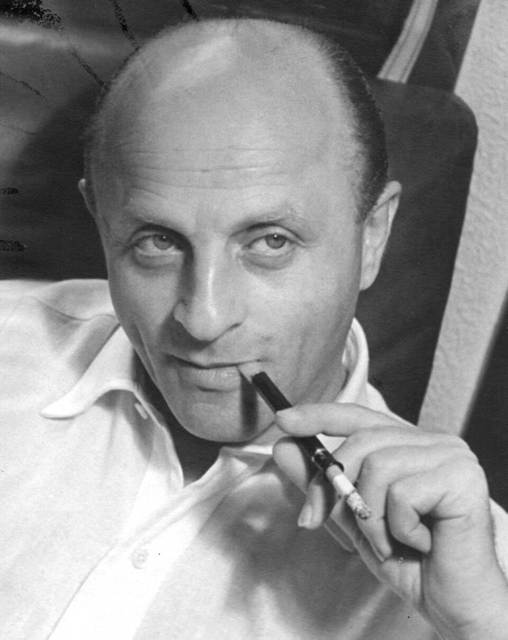
Bíró László Bíró was born to a Hungarian Jewish family in Budapest, Kingdom
of Hungary, within the Austro-Hungarian Empire, in 1899 to Mózes Mátyás
Schweiger and Janka Ullmann. The Schweigers changed
their Jewish name to Bíró in 1905. After leaving school, Bíró began work as a
journalist in Hungary. While working as a journalist, Bíró noticed that the ink used in
newspaper printing dried quickly, leaving the paper dry and smudge-free. He
tried using the same ink in a fountain pen, but
found that it would not flow into the tip, as it was too viscous. In 1930 he
observed children playing with marbles in a puddle, noticing that the marbles
left a trail of water in their wake. This gave him an idea: Why not use a
ball-shaped metal nib for writing, which became the initial design idea for
the ball pen. Bíró's
innovation successfully coupled viscous ink with a ball-and-socket mechanism
that allowed controlled flow while preventing ink from drying inside the
reservoir. Bíró filed for a British patent on 15 June 1938.This design
significantly improved the writing experience and made the pen more practical
for everyday use.
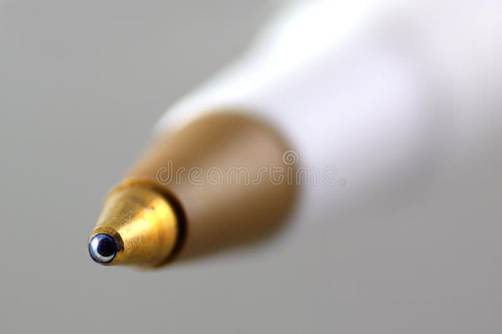
Tip of a ball point pen Post-World War II Popularity: After World War II, the ballpoint
pen gained widespread popularity due to its reliability and convenience. It
became a preferred writing instrument in schools, offices, and homes around
the world, largely replacing fountain pens. Continued Innovation: Over the decades, various improvements
have been made to the ballpoint pen, including advancements in ink
formulation and pen design. Today, ballpoint pens are available in numerous
styles and colors, catering to a wide range of preferences and uses. Ballpoint pen ink is normally a paste containing around 25 to 40
percent dye. The dyes are suspended in a mixture of solvents and fatty acids.
The most common of the solvents are benzyl alcohol or phenoxyethanol, which
mix with the dyes and oils to create a smooth paste that dries quickly. This
type of ink is also called "oil-based ink". The fatty acids help to
lubricate the ball tip while writing. Hybrid inks also contain added
lubricants in the ink to provide a smoother writing experience. The drying
time of the ink varies depending upon the viscosity of the ink and the
diameter of the ball. In general, the more viscous the ink, the faster it will dry,
but more writing pressure needs to be applied to dispense ink. Although they
are less viscous, hybrid inks have a faster drying time compared to normal
ballpoint inks. Also, a larger ball dispenses more ink and thus increases
drying time. The dyes used in blue and black ballpoint pens are basic dyes
based on triarylmethane and acid dyes derived from diazo compounds or
phthalocyanine. Common dyes in blue (and black) ink are Prussian blue,
Victoria blue, methyl violet, crystal violet, and phthalocyanine blue. The
dye eosin is commonly used for red ink. In the 2000s, China ballpoint pen production skyrocketed. In
2017, China produced 38 billion ballpoint pens per year, 80% of the global
market. But the country had a problem in precision engineering the ballpoint
pen tip, which had to be imported from Germany, Switzerland, and Japan for
the cost of ¥ 120 million a year It is generally believed that gravity is needed to coat the ball
with ink. In fact most ballpoint pens on the Earth
do not work when writing upside-down because the Earth's gravity pulls the
ink inside the pen away from the tip of the pen. However, in the microgravity
environment of space a regular ballpoint pen can still work, pointed in any
direction, because the capillary forces in the ink are stronger than non present gravitational forces. Technology developed by Fisher pens in the United States
resulted in the production of what came to be known as the "Fisher Space
Pen". Space Pens combine a more viscous ink with a pressurized ink
reservoir that forces the ink toward the point. Unlike a standard ballpoint's
ink container, the rear end of a Space Pen's pressurized reservoir is sealed,
eliminating evaporation and leakage, thus allowing the pen to write
upside-down, in zero-gravity environments, and underwater. Astronauts have made
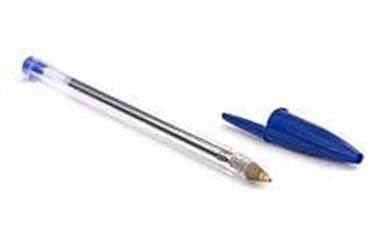
use of these pens in outer space. The world's most popular pen is the Bic Cristal, with the 100
billionth model sold in September, 2006. The Bic
Cristal was launched in December 1950 and roughly 57 are sold per second.
Bic Cristal
1939 Start of world war II,
a global conflict between two coalitions: the Allies and the Axis powers.
Nearly all of the world's countries participated, with many nations
mobilizing all resources in pursuit of total war. Tanks and aircraft played
major roles, enabling the strategic bombing of cities and delivery of the
first and only nuclear weapons ever used in war. World
War II is the deadliest conflict in history, causing the death of 70 to 85
million people, more than half of whom were civilians. Millions died in
genocides, including the Holocaust, and by massacres, starvation, and
disease. After the Allied victory, Germany, Austria, Japan, and Korea were
occupied, and German and Japanese leaders were tried for war crimes. The
causes of World War II included unresolved tensions in the aftermath of World
War I, the rise of fascism in Europe and militarism in Japan. Key events
preceding the war included Japan's invasion of Manchuria in 1931, the Spanish
Civil War, the outbreak of the Second Sino-Japanese War in 1937, and
Germany's annexations of Austria and the Sudetenland. World
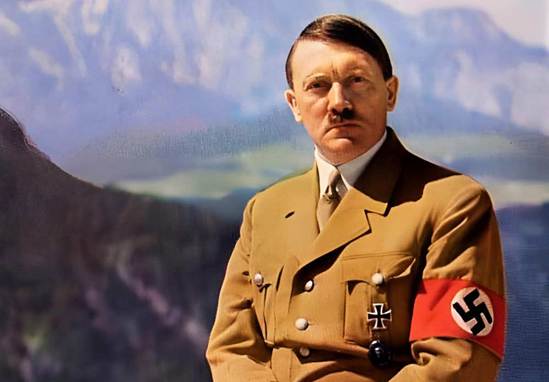
War II is generally considered to have begun on 1 September 1939, when Nazi
Germany, under Adolf Hitler, invaded Poland, after which the United Kingdom
and France declared war on Germany.
Poland
was divided between Germany and the Soviet Union under the Molotov–Ribbentrop
Pact. In 1940, the Soviet Union annexed the Baltic states and parts of
Finland and Romania. After the fall of France in June 1940, the war continued
mainly between Germany and the British Empire, with fighting in the Balkans,
Mediterranean, and Middle East, the aerial Battle of Britain and the Blitz,
and the naval Battle of the Atlantic. Through campaigns and treaties, Germany
gained control of much of continental Europe and formed the Axis alliance
with Italy, Japan, and other countries. In June 1941, Germany invaded the
Soviet Union, opening the Eastern Front and initially making large
territorial gains.
1940 Penicillin
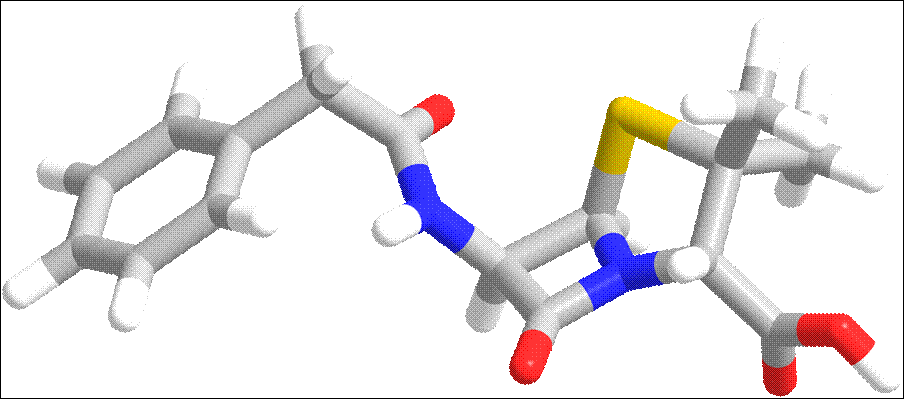
begins mass production, Benzylpenicillin,
also known as penicillin G
or BENPEN, is an antibiotic used to treat a number of bacterial
infections. This includes pneumonia, strep throat, syphilis, necrotizing
enterocolitis, diphtheria, gas gangrene, leptospirosis, cellulitis, and
tetanus. Discovered
by the Scottish physician Alexander Fleming as a crude extract of P. rubens.
Fleming's student Cecil George Paine was the first to successfully use
penicillin to treat eye infection (neonatal conjunctivitis) in 1930. The
purified compound (penicillin F) was isolated in 1940 by a research team led
by Howard Florey and Ernst Boris Chain at the University of Oxford. Fleming
first used purified penicillin to treat streptococcal meningitis in 1942. The
1945 Nobel Prize in Physiology or Medicine was shared by Chain, Fleming and
Florey.
With
the onset of World War II, the US government funds the mass production of
penicillin as a way to treat wounded soldiers. The drug is produced in large
quantities using deep-tank fermentation, which allows for a more efficient
and cost-effective production process. This
discovery revolutionized medicine and helped to save millions of lives by
treating bacterial infections. Over the next few decades, other antibiotics
were discovered, including streptomycin, tetracycline, and erythromycin.
However, the overuse and misuse of antibiotics led to the development of
antibiotic-resistant bacteria, which have become a
major public health concern. In recent years, efforts have been made to
promote responsible antibiotic use and find new ways to combat antibiotic
resistance.
Beginning
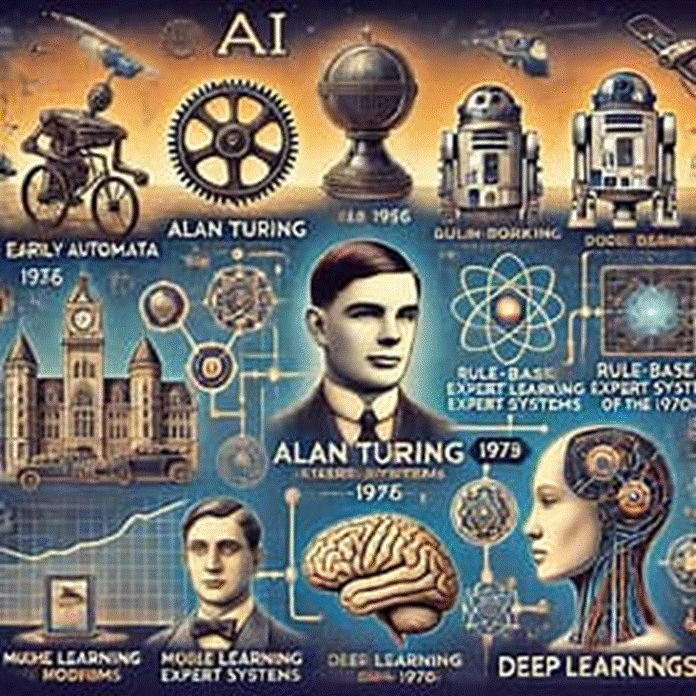
of artificial intelligence (AI), It
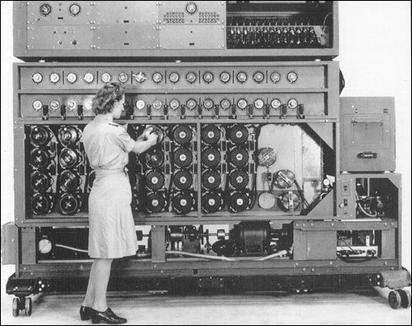
all started back in time of World War II. Allied forces were desperate to
crack German military codes. Alan Turing built a machine called the Bombe,
which helped decrypt messages from the German Enigma machine.
Turing’s
machine could scan through thousands of possible code combinations in a
flash. It saved countless lives and proved one key thing: machines can solve
problems faster than humans - if built right. A
few years later, 1950,
Turing posed a question that still fuels debates today: "Can machines
think?" And to answer it, he came up with a clever experiment - The
Turing Test. It
was like chatting with someone behind a screen. You don’t know if it’s a
human or a machine. If you can't tell the difference, the machine has passed
the test. Pretty cool, right? Turing basically gave us the blueprint for
evaluating artificial intelligence before the term even existed. In
1955,
John McCarthy proposed the term 'Artificial Intelligence,' which was
officially introduced in 1956 at the Dartmouth Conference. He
believed machines could one day think, learn, and solve problems like humans.
It was a bold idea back then. He wasn’t just dreaming - he was building. In 1958,
McCarthy also created LISP, a programming language still used in AI today. He
was the one who hosted the first AI conference at Dartmouth, where pioneers
gathered to bring this wild concept to life. Robots
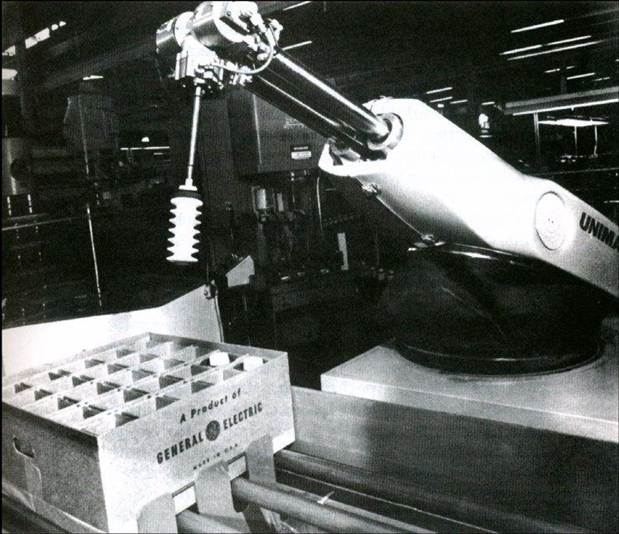
weren't just science fiction anymore. In 1961,
Unimate became the world’s first industrial robot.
It worked at a General Motors factory, moving hot metal parts and doing risky
tasks that were dangerous for humans.
It
was a bulky arm that weighed over 4,000 pounds. But it was a game-changer. After Unimate’s
success, more factories began using robots to handle dangerous or repetitive
work. In
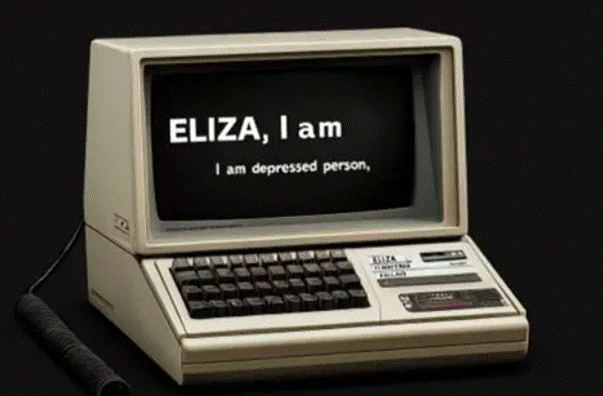
1964,
ELIZA was born at MIT. Created by Joseph Weizenbaum, ELIZA was designed to
simulate a conversation with a therapist. She wasn’t exactly deep, but she
was clever.
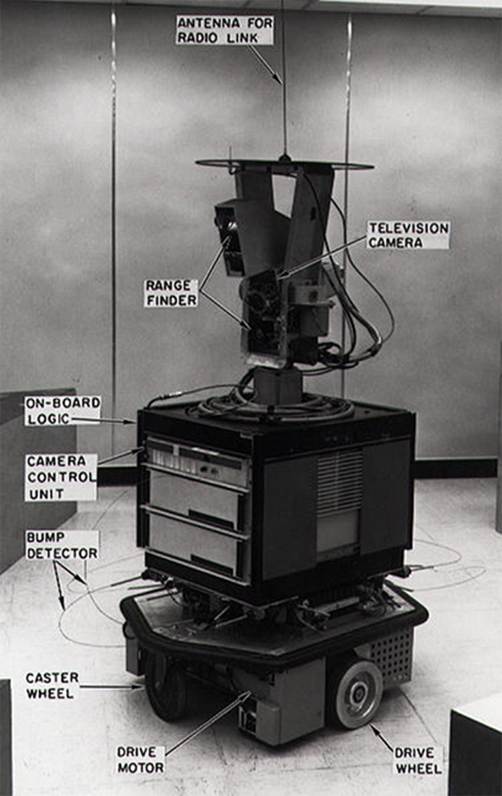
Next
came a robot with a little brain of its own. Shakey was different. Built in 1969,
he could actually make decisions. He looked around, figured out where he was,
made plans, and even adjusted them if something went wrong. He
didn’t just follow instructions - he thought through his actions, which was unheard of back then. Shakey was the first robot that
could "see," "think," and "move" all by itself.
Basically, he was the great-grandfather of smart robots and autonomous
vehicles.
By
the ‘90s, chatbots had gotten smarter. ALICE, created by Richard Wallace,
took things up a notch. Unlike ELIZA, she used natural language processing to
hold more human-like conversations. She
could respond to a wide range of questions and even had a bit of sass. ALICE
won multiple awards and inspired the movie Her, where a man falls in love
with an AI assistant. Yep, chatbots were officially getting personal.
1997
gave us one of AI’s most iconic moments. IBM’s Deep Blue, a chess-playing
supercomputer, went head-to-head with world champion Garry Kasparov - and
won. It was a dramatic battle of man vs. machine. AI
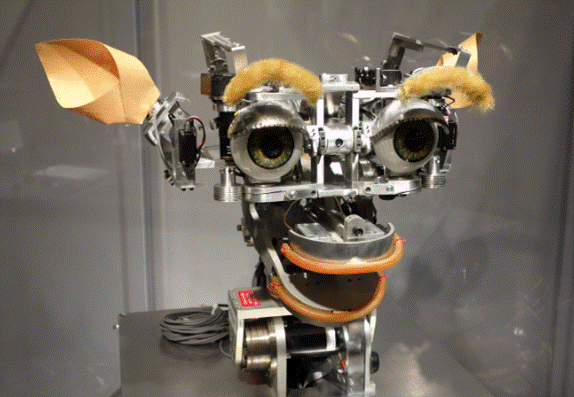
wasn’t just getting smarter - it was learning emotions. Meet Kismet, a robot
developed at MIT 1998
that could mimic human facial expressions and emotional responses. It had
moving eyes, eyebrows, and even a mouth to show surprise, happiness, or
frustration.
Kismet
wasn’t just about logic; it was about emotionally connecting with people. It
paved the way for emotionally intelligent AI, like the ones in customer
support and caregiving robots today. In
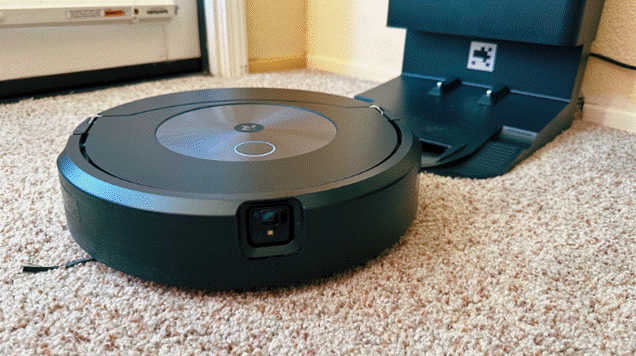
2002,
Roomba arrived—a little round robot that could vacuum your home by itself. It
had sensors to avoid walls, fall off stairs, and navigate your living room
like a pro.
In
2011,
millions met Siri, Apple’s brand-new voice assistant. You could ask her about
the weather, set reminders, or even joke around with questions like, “Do you
love me?” And yep - she’d answer. Sort of. Siri
wasn’t the first voice assistant ever, but she was the first mainstream AI
you could talk to. Apple integrated her into the iPhone 4S, and suddenly,
talking to your phone became normal. She
changed how we thought about interacting with tech. Honestly, it felt like
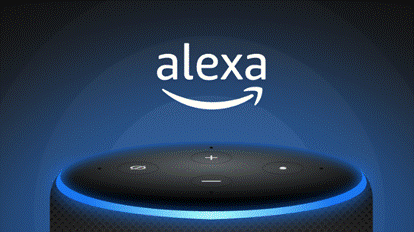
having a little AI buddy in your pocket. Next
in the AI timeline is Alexa 2014,
an Amazon virtual assistant. You say “Alexa,” and it lights up, even in a
noisy room. It can play music, give you news or weather updates, control
smart devices, and even help you order from Amazon.
It’s
on everything now; smartwatches, speakers, TVs, even in cars. Yep, Alexa’s
everywhere. Amper
was the first AI to write 2017,
produce, and release music. It helps musicians by creating original tracks
using AI and music theory. In fact, Amper teamed up with singer Taryn
Southern for a groundbreaking album called I AM AI. The song “Break Free”
marked their first human-AI collaboration. In
2025,
AI isn’t just a tool—it’s a teammate. It helps us think faster, create
smarter, and do more with less. Whether you're a student, artist, or business
owner, AI is now your co-pilot. It is always there, guiding, generating, and
learning with you every step of the way.
|