Home
About
Links
Hobbycraft
Photos
Downloads
|
1946 Donald Trump was
born, at
Jamaica Hospital in the New York City borough of Queens, the fourth child of
Fred Trump and Mary Anne MacLeod Trump. He is of German and Scottish descent.
He grew up with his older siblings, Maryanne, Fred Jr., and Elizabeth, and
his younger brother, Robert, in a 23-room mansion in the Jamaica Estates
neighborhood of Queens. Fred Trump paid his children each about $20,000 a
year, equivalent to $265,000 a year in 2024. Trump was a millionaire in
inflation-adjusted dollars by age eight.
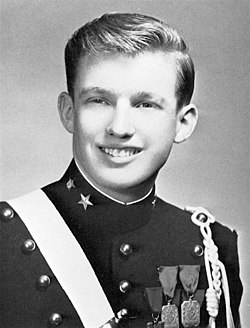
1964 yearbook
photo American
politician, media personality, and businessman who is the 47th president of
the United States. A member of the Republican Party, he served as the 45th
president from 2017 to 2021. I
have much more information at: http://vernonite.com/photos.favorite.trump.html
Cell phones become available, the
Mobile Telephone Service (MTS) launch in 1946, or
the first-ever wireless telephony system. During
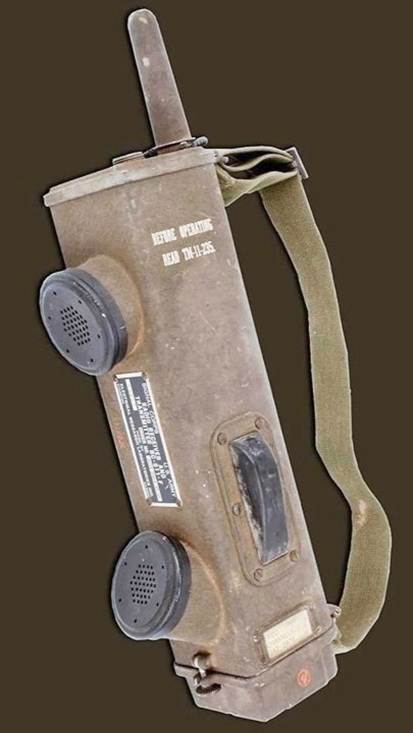
the Second World War, the Allied powers deployed over 130,000 units of the
SCR-536 Handie-Talkie (pictured below). This
bulky contraption was essentially an entirely handheld two-way radio
transceiver. As you’d expect from such an early
technology, it suffered many drawbacks, including short battery life and a
lackluster range of just one mile depending on the terrain. Still, it was
more than useable, and the company behind it would eventually become the
Motorola we know today.
After
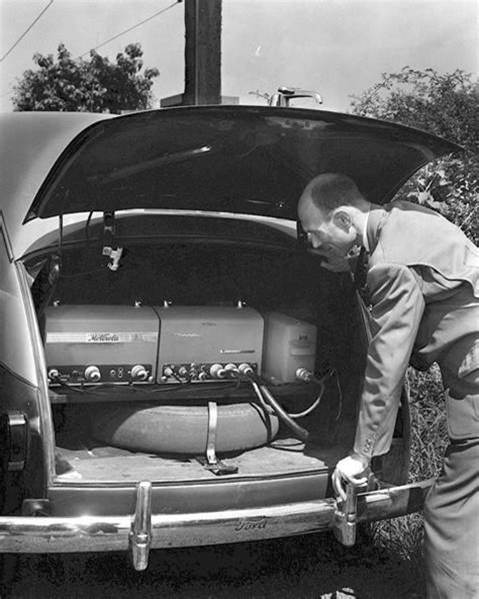
the war ended, American company Bell Labs began working on an in-car system
allowing users to place calls from anywhere. This led to the Mobile Telephone
Service (MTS) launch in 1946, or the first-ever wireless telephony system. Bell
Labs’ car phone equipment weighed 80 pounds in its first generation. And even
with all that weight, you could only use it in major US cities and along
select highways. Despite these limitations, the service quickly gained
popularity. It became so popular that the service quickly reached its maximum
capacity due to the limited radio channels available at each base station.
Users would have to wait in line for a channel to become available.
First car telephone Car
phones became increasingly popular among businesses and wealthy individuals
in the 1950s and 1960s, but the high cost meant they remained out of reach
for most people.
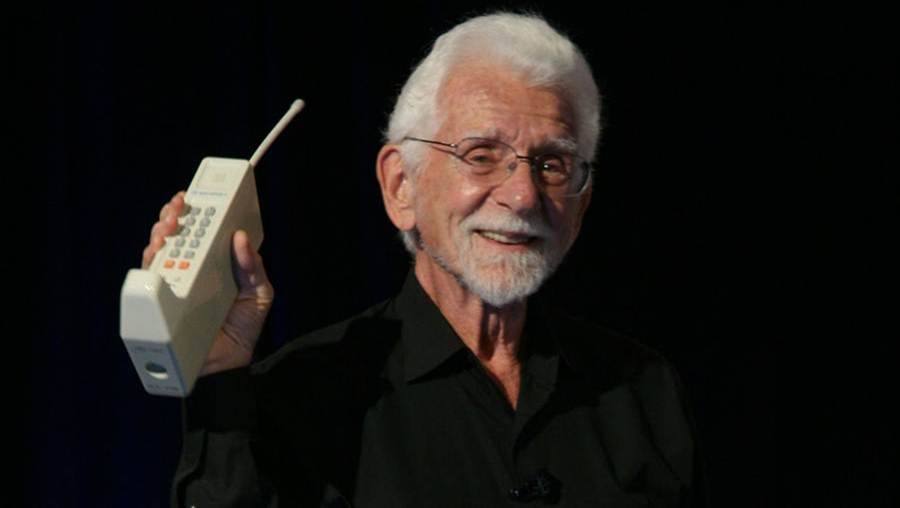
In 1983, Motorola would finally go to market with
the DynaTAC 8000X. The phone was nearly a
foot long and weighed roughly 2.5 lbs (over
a kilogram). Still, anyone could buy one, which was revolutionary enough
then. And despite its eye-watering $4,000 asking price, Motorola reportedly
couldn’t manufacture enough units to keep up with demand. The DynaTAC 8000X used a brand-new cellular network,
specifically Bell Labs’ Advanced Mobile Phone System (AMPS). These days, we
refer to AMPS as a first-generation cellular network (1G) or the precursor to
2G. AMPS was susceptible to signal noise and static as a purely analog
network. It didn’t support text messaging or SMS either. The DynaTAC 8000X could store 30 contacts but offered
little else in the way of features otherwise. It
didn’t take long for more companies to follow in Motorola’s footsteps. Nokia,
for example, entered the cell phone market in 1987 with the Mobira Cityman 900.
The phone’s 1.6 lbs (760g) weight
represented a significant upgrade over the DynaTAC. Released
in 1994, the Nokia 2010 featured a numeric keypad with letter mappings for
text input. Motorola,
meanwhile, released the first-ever clamshell-style flip phone in 1996.
The StarTAC’s top half folded down to
protect the display and keypad. However, Motorola’s big selling point for the
device was its impressive 3oz (88g) weight. Towards
the end of the 20th century, we also saw the future potential of cell phones
with the BlackBerry 850. The device featured a 32-bit Intel processor, a full
horizontal keyboard, and encrypted email software — all for just $400. The
company behind BlackBerry, Research in Motion, would go on to dominate the
enterprise cell phone market over the next decade. In
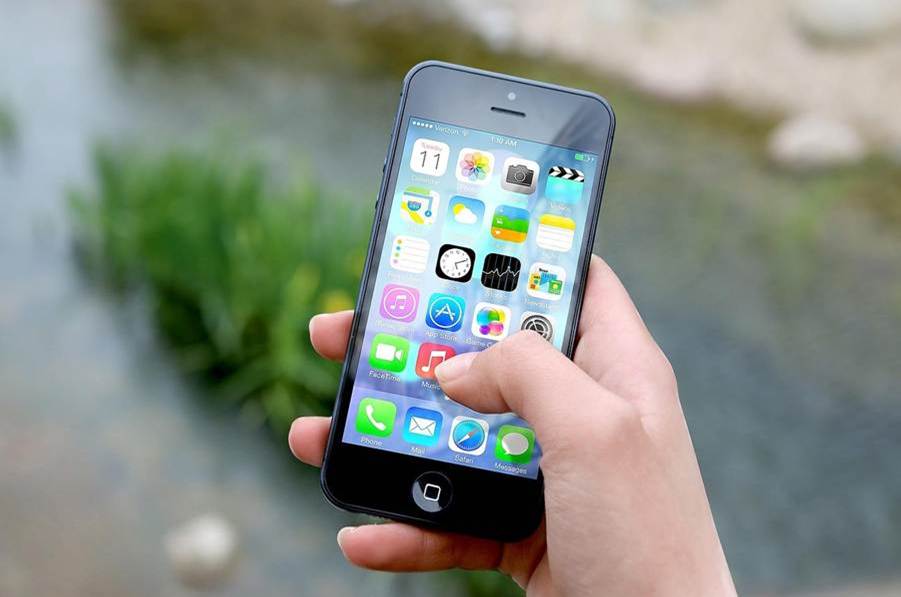
2007, Apple entered the cell phone market with the iPhone. The company
announced it as “a revolutionary mobile phone, a widescreen iPod with touch
controls, and a breakthrough Internet communications device.” Indeed, it was
the first phone to fully embrace the touch interface and fulfill three use
cases in a single device.
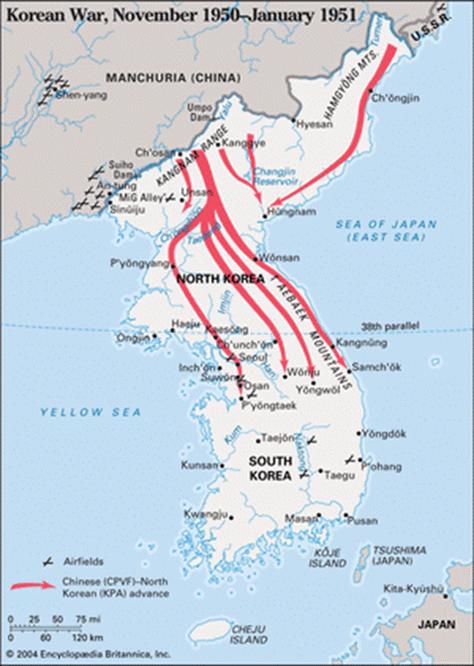
1950 Korean
War, conflict between the
Democratic People’s Republic of Korea (North Korea) and the Republic of Korea
(South Korea) in which at least 2.5 million persons lost their lives. The war
reached international proportions in June 1950 when North Korea, supplied and
advised by the Soviet Union, invaded the South. The United Nations, with the
United States as the principal participant, joined the war on the side of the
South Koreans, and the People’s Republic of China came to North Korea’s aid.
After more than a million combat casualties had been suffered on both sides,
the fighting ended in July 1953 with Korea still divided into two hostile
states. Negotiations in 1954 produced no further agreement, and the front
line has been accepted ever since as the de facto boundary between North and
South Korea. The Korean War had its
immediate origins in the collapse of the Japanese empire at the end of World
War II in September 1945. In their hurried effort to disarm the Japanese army
and repatriate the Japanese population in Korea (estimated at 700,000), the United
States and the Soviet Union agreed in August 1945 to divide the country for
administrative purposes at the 38th parallel (latitude 38° N). At least from
the American perspective, this geographic division was a temporary expedient;
however, the Soviets began a short-lived reign of terror in northern Korea
that quickly politicized the division by driving thousands of refugees south. The two sides could not
agree on a formula that would produce a unified Korea, and in 1947 U.S.
President Harry S. Truman persuaded the United Nations (UN) to assume
responsibility for the country, though the U.S. military remained nominally
in control of the South until 1948. In the predawn hours of
June 25, the North Koreans struck across the 38th parallel behind a
thunderous artillery barrage. The principal offensive, conducted by the KPA I
Corps (53,000 men), drove across the Imjin River
toward Seoul. The II Corps (54,000 soldiers) attacked along two widely
separated axes, one through the cities of Ch’unch’ŏn and
Inje to Hongch’ŏn and the other down
the east coast road toward Kangnŭng. The
KPA entered Seoul in the afternoon of June 28, but the North Koreans did not
accomplish their goal of a quick surrender by the Rhee government and the
disintegration of the South Korean army. Instead, remnants of the Seoul-area
ROKA forces formed a defensive line south of the Han River, and on the east
coast road ROKA units gave ground in good order. Still, if the South was to
stave off collapse, it would need help—from the U.S. armed forces.
Truman’s initial response
was to order MacArthur to transfer munitions to the ROKA and to use air cover
to protect the evacuation of U.S. citizens. Instead of pressing for a
congressional declaration of war, which he regarded as too alarmist and
time-consuming when time was of the essence, Truman went to the United
Nations for sanction. Under U.S. guidance, the UN called for the invasion to
halt (June 25), then for the UN member states to provide military assistance
to the ROK (June 27). From September to November
1952, the Chinese expeditionary force staged its sixth major offensive of the
war, this time to force the allies back to the 38th parallel and to inflict
unacceptable casualties on them. Raging from the valley of the Imjin through the Iron Triangle to the eastern
mountains, the ground war followed the same dismal pattern. The Chinese infiltrated
allied outposts at night, then attacked under the support of short, intense
artillery barrages. Submachine guns and hand grenades ruled the trenches, and
flamethrowers and demolitions became standard weapons for assault units. Obscure
hills acquired memorable names: White Horse Mountain, Bunker Hill, Old Baldy,
Sniper Ridge, Capitol Hill, Triangle Hill, Pike’s Peak, Jackson Heights, and
Jane Russell Hill. By the time fighting faded in mid-November, the Eighth
Army had lost 10,000 men, the Chinese 15,000. Chinese commanders hoped that
they had persuaded president-elect Eisenhower to abandon any ambitious plans
for a major offensive in 1953 On March 5, 1953, Joseph
Stalin died, and within weeks the Politburo of the Soviet Communist Party
voted that the war in Korea should be ended. Mao Zedong received the news
with dismay, but he knew that his army could not continue the war without
Soviet assistance. With a speed that amazed the negotiating teams on both
sides, the Chinese accepted voluntary repatriation. POWs who wanted to return
to their homelands would be released immediately,
and those who chose to stay would go into the custody of a neutral
international agency for noncoercive screening. The Chinese and North Koreans
also agreed to the exchange of sick and disabled POWs, which took place
between April 20 and May 3. Peace was not yet at hand,
however. Rhee had never publicly surrendered his “march north and unify”
position, and in private he hinted that he might “accept” an armistice only
in return for serious commitments by the United States, including an
unambiguous mutual security alliance and $1 billion in economic aid. The
Chinese, meanwhile, saw but one way to win concessions and territory in a
peace agreement: on the battlefield. Their seventh and final offensive opened
in the Imjin River sector in May against
U.S. and Commonwealth divisions, then shifted to the South Koreans, who were
driven back 30 km (about 19 miles) from the Kŭmsong salient.
The
Korean peninsula would continue to be caught in the coils of Cold War
rivalry, but the survival of the Republic of Korea kept alive the hope of
civil liberties, democracy, economic development, and eventual
unification—even if their fulfillment might require another 50 years or more. |