Home
About
Links
Hobbycraft
Photos
Downloads
|
Earliest forms of life |
|
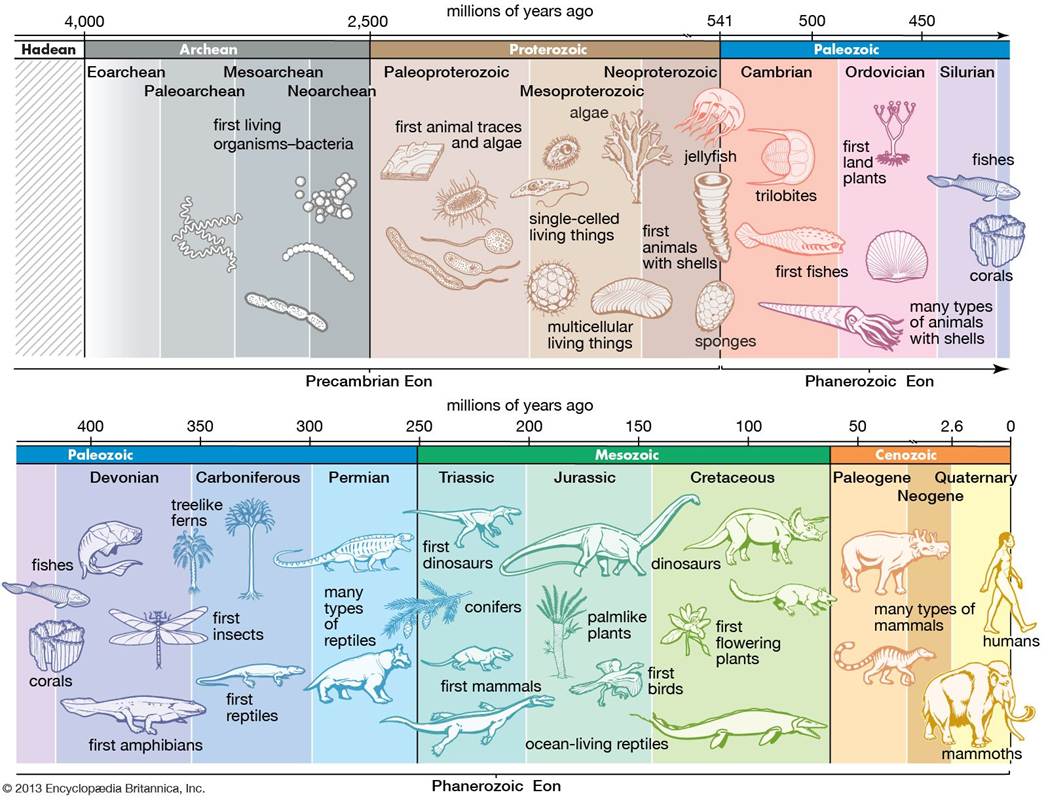
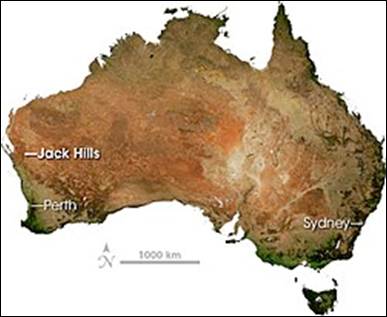
4,100,000,000 (4.1 billion years ago) The
first microbial life on Earth according
to biologically fractionated graphite inside a single zircon grain in the
Jack Hills range of Australia. Potentially biogenic carbon isotope ratios
have been identified for graphite embedded within a zircon from the site.
|
|
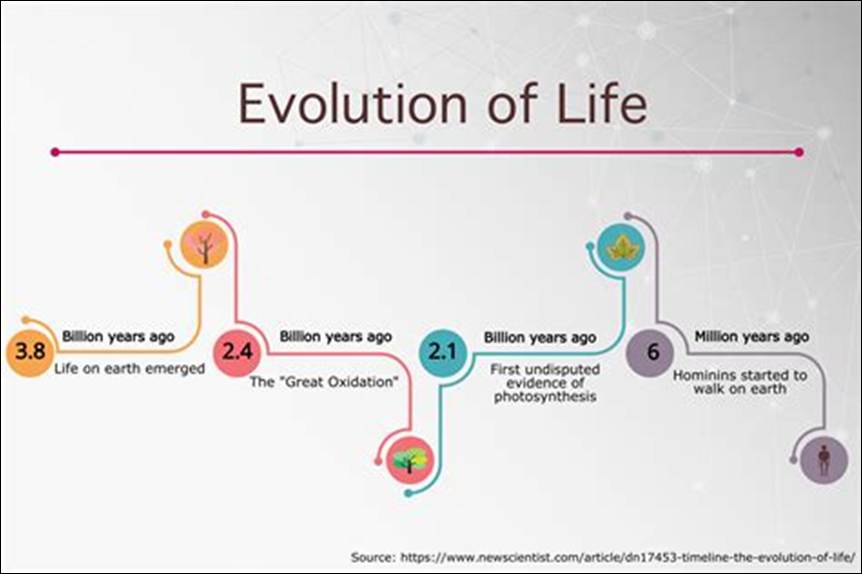
3,800,000,000 First
living organisms on earth, first microbial life emerges in
earth’s oceans The earliest life forms we know of were microscopic organisms
(microbes) that left signals of their presence in rocks. The signals
consisted of a type of carbon molecule that is produced by living things. Evidence of microbes was also preserved in the hard structures
(“stromatolites”) they made. Stromatolites are created as sticky mats of
microbe’s trap and bind sediments into layers. Minerals precipitate inside
the layers, creating durable structures even as the microbes die off
|
|
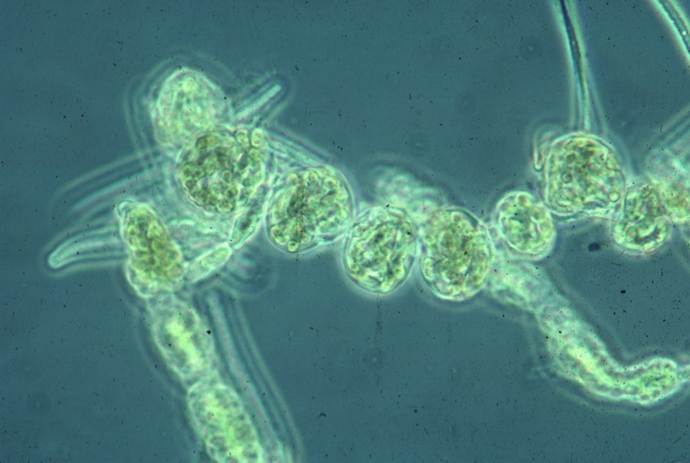
2,400,000,000 Photosynthesizing
bacteria evolved Cyanobacteria, which developed oxygenic photosynthesis, emerged significantly impacting Earth's atmosphere by releasing oxygen into the atmosphere via photosynthesis and, in a few hundred million years, were able to change the composition of the atmosphere into what we have today. Our modern atmosphere is comprised of 78 percent nitrogen and 21 percent oxygen, among other gases, which enables it to support the many lives residing within it.
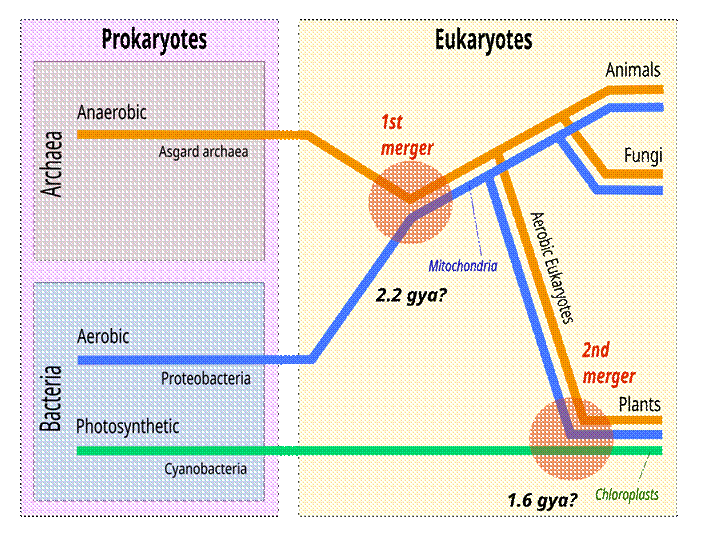
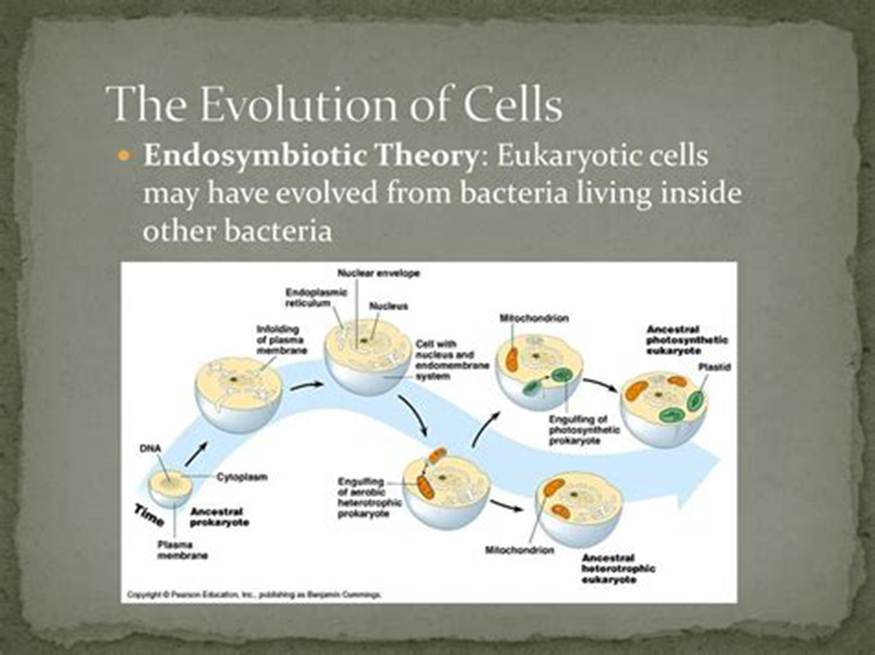
2,100,000,000 Eukaryotic
cell evolved through
a process called eukaryogenesis, which likely involved the merging of an
archaeal cell with one or more bacteria in a symbiotic relationship. This led
to the development of complex cellular
structures, including a membrane-bound nucleus and organelles like
mitochondria
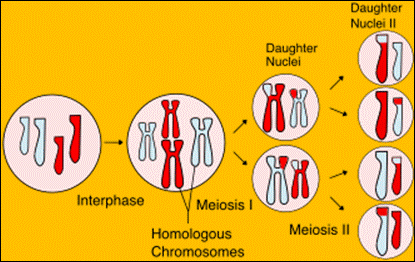
1,200,000,000 Meiosis, a
special type of cell division of germ cells in sexually reproducing organisms
that produces the gametes, the sperm or egg cells. It involves two rounds of
division that ultimately result in four cells, each with only one copy of
each chromosome (haploid). Additionally, prior to the division, genetic
material from the paternal and maternal copies of each chromosome is crossed
over, creating new combinations of code on each chromosome. Later on, during
fertilization, the haploid cells produced by meiosis from a male and a female
will fuse to create a zygote, a cell with two copies of each chromosome.
In meiosis, the chromosomes duplicate (during interphase) and
homologous chromosomes exchange genetic information (chromosomal crossover)
during the first division, called meiosis I. The daughter cells divide again
in meiosis II, splitting up sister chromatids to form haploid gametes. Two
gametes fuse during fertilization, forming a diploid cell (zygote) with a
complete set of paired chromosomes. Meiosis occurs in all sexually reproducing single-celled and
multicellular organisms (which are all eukaryotes), including animals,
plants, and fungi. It is an essential process for oogenesis and
spermatogenesis. 1,000,000,000 First non-marine eukaryotes move to land, they were photosynthetic and multicellular,
organisms with complex cells that live in freshwater or terrestrial
environments, as opposed to marine settings. A multicellular organism is
an organism that consists of more than one cell, and more than one cell type,
unlike unicellular organisms. All species of animals, land plants and most
fungi are multicellular, as are many algae, whereas a few organisms are partially
uni- and partially multicellular, like slime molds and social amoebae such as
the genus Dictyostelium. Multicellular organisms
arise in various ways, for example by cell division or by aggregation of many
single cells. Colonial organisms are the result of many identical individuals
joining together to form a colony. The origin of
multicellularity is that a group of function-specific cells aggregated into a
slug-like mass called a grex, which moved as a multicellular unit. This is
essentially what slime molds do. Another hypothesis is that a primitive cell
underwent nucleus division, thereby becoming a coenocyte. A membrane would
then form around each nucleus (and the cellular space and organelles occupied
in the space), thereby resulting in a group of connected cells in one
organism (this mechanism is observable in Drosophila). A third hypothesis is
that as a unicellular organism divided, the daughter cells failed to
separate, resulting in a conglomeration of identical cells in one organism,
which could later develop specialized tissues. This is what plant and animal embryos
do as well as colonial choanoflagellates. Because the first
multicellular organisms were simple, soft organisms lacking bone, shell, or
other hard body parts, they are not well preserved in the fossil record. The colonial theory of
Haeckel, 1874, proposes that the symbiosis of many organisms of the same
species (unlike the symbiotic theory, which suggests the symbiosis of
different species) led to a multicellular organism. At least some – it is
presumed land-evolved – multicellularity occurs by cells separating and then
rejoining (e.g., cellular slime molds) whereas for the majority of
multicellular types (those that evolved within aquatic environments),
multicellularity occurs as a consequence of cells failing to separate
following division. The mechanism of this latter colony formation can be as
simple as incomplete cytokinesis, though multicellularity is also typically
considered to involve cellular differentiation. 750,000,000 Beginning
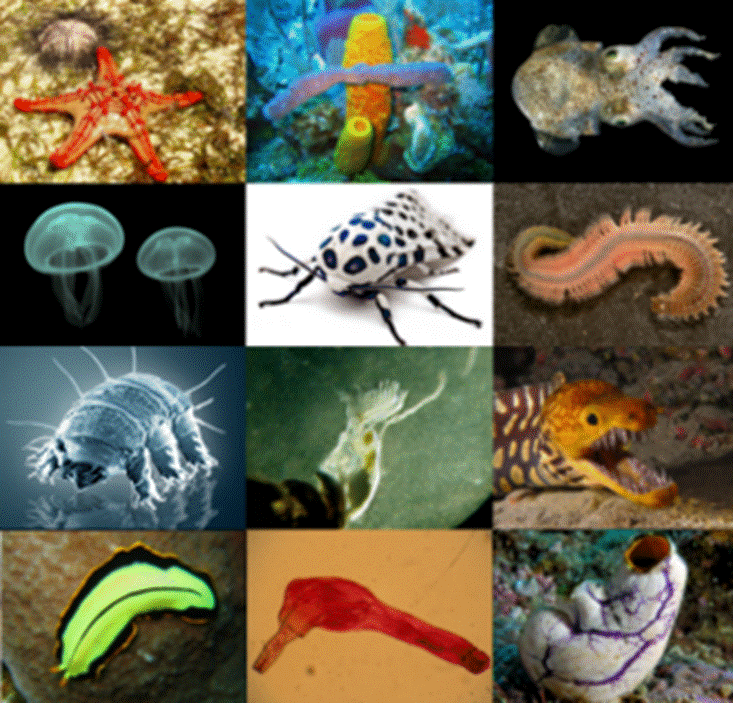
of animal evolution, multicellular, eukaryotic organisms
comprising the biological kingdom Animalia. Animals consume organic material,
breathe oxygen, have myocytes and are able to move, can reproduce sexually,
and grow from a hollow sphere of cells, the blastula, during embryonic
development. Animals form a clade, meaning that they arose from a single
common ancestor. Over 1.5 million living animal species have been described, of
which around 1.05 million are insects, over 85,000 are molluscs,
and around 65,000 are vertebrates. It has been estimated there are as many as
7.77 million animal species on Earth. Animal body lengths range from 0.00033
inches to 110 feet. They have complex ecologies and interactions with each
other and their environments, forming intricate food webs.
Nearly all animals make use of some form of sexual reproduction.
They produce haploid gametes by meiosis; the
smaller, motile gametes are spermatozoa, and the larger, non-motile gametes
are ova. These fuse to form zygotes, which develop via mitosis into a hollow
sphere, called a blastula. In sponges, blastula larvae swim to a new
location, attach to the seabed, and develop into a new sponge. In most other
groups, the blastula undergoes more complicated rearrangement. It first
invaginates to form a gastrula with a digestive chamber and two separate germ
layers, an external ectoderm and an internal endoderm. In most cases, a third
germ layer, the mesoderm, also develops between them. These germ layers then
differentiate from tissues and organs. Some animals are capable of asexual reproduction, which often
results in a genetic clone of the parent. This may take place through
fragmentation; budding, such as in Hydra and other cnidarians; or
parthenogenesis, where fertile eggs are produced without mating, such as in
aphids. The blue whale (Balaenoptera musculus) is the largest animal
that has ever lived, weighing up to 200 tons and
measuring up to 110 ft long. The largest extant terrestrial animal is the
African bush elephant, weighing up to 13 tons and measuring up to 35 feet
long. The largest terrestrial animals that ever lived were titanosaur
sauropod dinosaurs such as Argentinosaurus, which may have weighed as much as
80 tons, and Supersaurus which may have reached 125 feet. Several animals are
microscopic; some Myxozoa (obligate parasites within the Cnidaria) never grow
larger than 20 micrometers and one of the smallest species (Myxobolus shekel) is no more than 8.5 micrometers when
fully grown. |