Home
About
Links
Hobbycraft
Photos
Downloads
From the beginning
13,800,000,000 Years ago
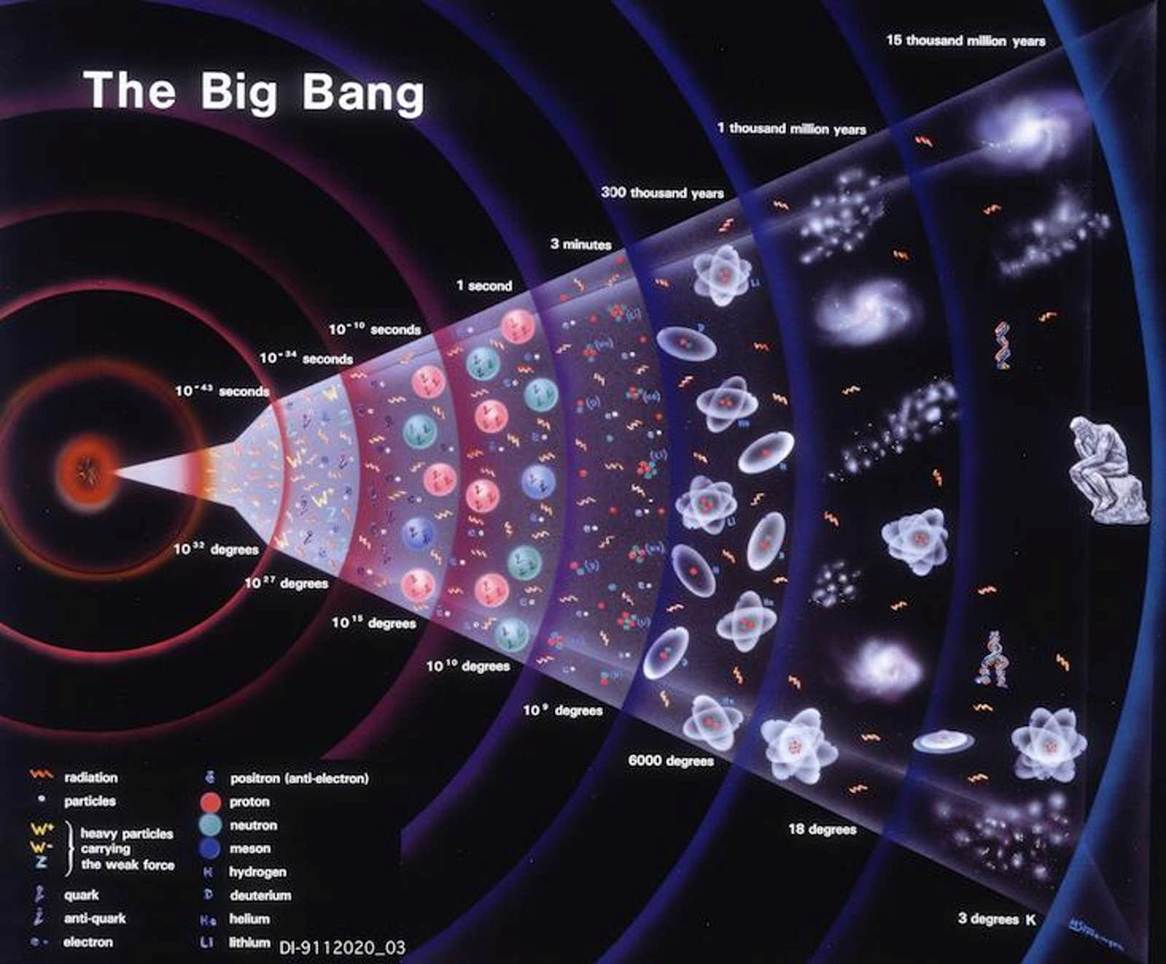
Big Bang, Hypothetical begin of the Universe
through expansion out of an infinitely small and infinitely dense state and
has been expanding ever since. Before time had a name, before light could shine, before
space itself could stretch or curve, there was nothing—no stars, no galaxies,
not even a void. Just an absence so profound that the very word “nothing”
seems inadequate. The Big Bang was not an explosion in space; it was an
explosion of space. It marked the beginning of time, energy, and matter. For
a brief moment, the universe was a furnace of unimaginable temperatures and
densities. As it expanded, it cooled rapidly. Within minutes, the first
atomic nuclei formed in a process known as Big Bang nucleosynthesis,
producing mostly hydrogen, with traces of helium and tiny amounts of lithium. The big-bang model relies on two main ideas: Einstein’s general relativity accurately describes gravity, and the cosmological principle holds that the universe looks the same in every direction and location on a large scale. This means the universe has no edge and the big bang happened everywhere at once. These assumptions allow scientists to calculate the universe’s history after the Planck time, but what happened before then remains unknown. Planck Time, which represents the smallest possible interval of time that can be measured. One Planck time is approximately 10-44 seconds.
|
13,600,000,000
|
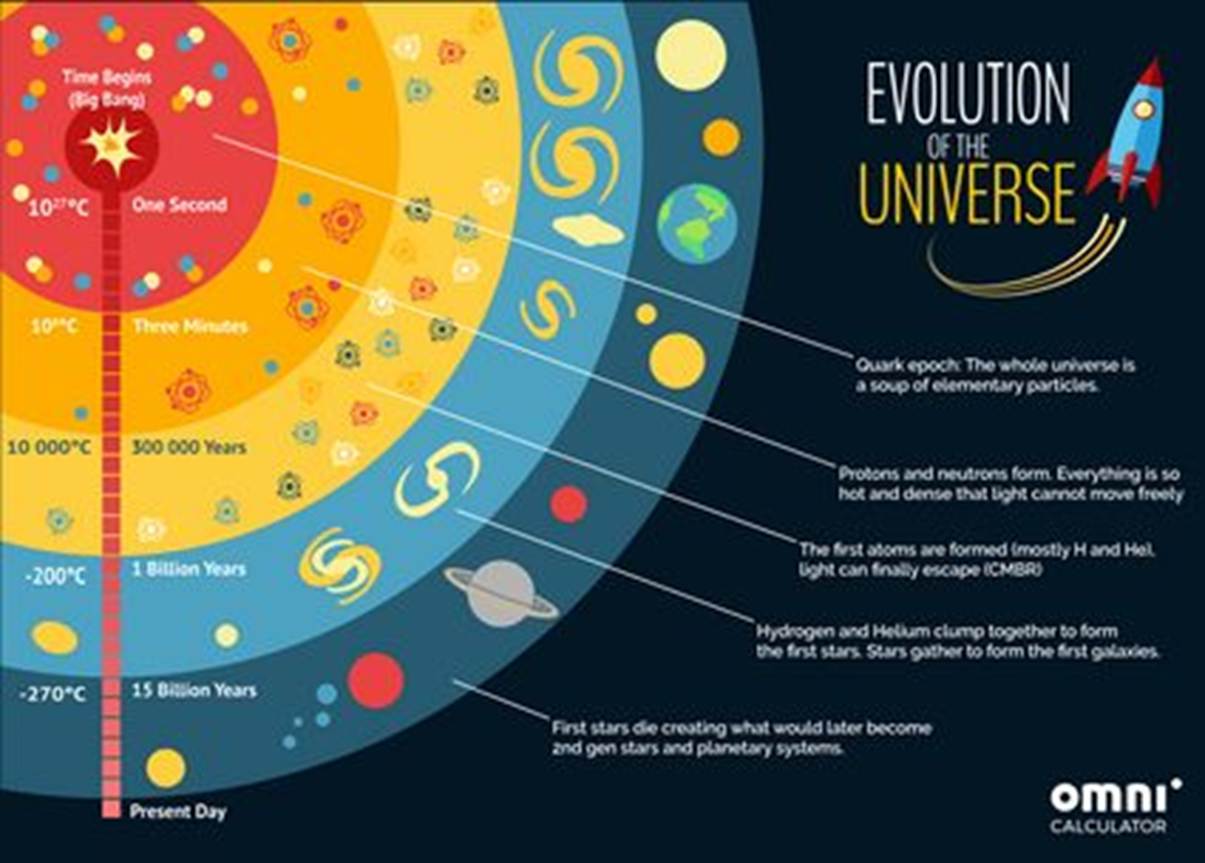
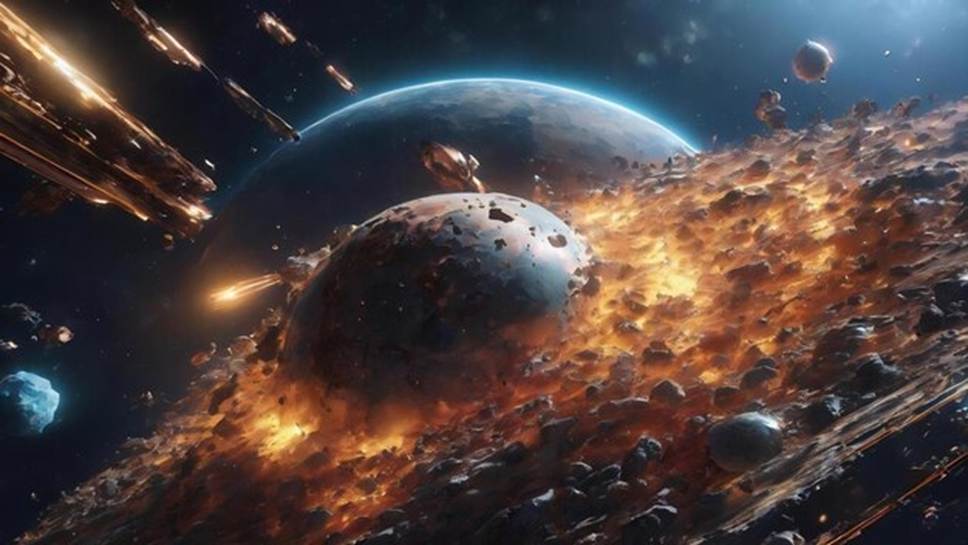
First particles, quarks, electrons, and other
fundamental particles form as the universe cools Matter is made of elementary particles called quarks and leptons, such as electrons. Quarks form protons and neutrons, which, together with electrons, create atoms like hydrogen, oxygen, and iron. Atoms form molecules, and these groups make up all bulk matter. Other forms include plasmas (ionized gases), foams (mixing liquid and solid properties), and clusters, which bridge atomic and bulk characteristics.
|
13,500,000,000
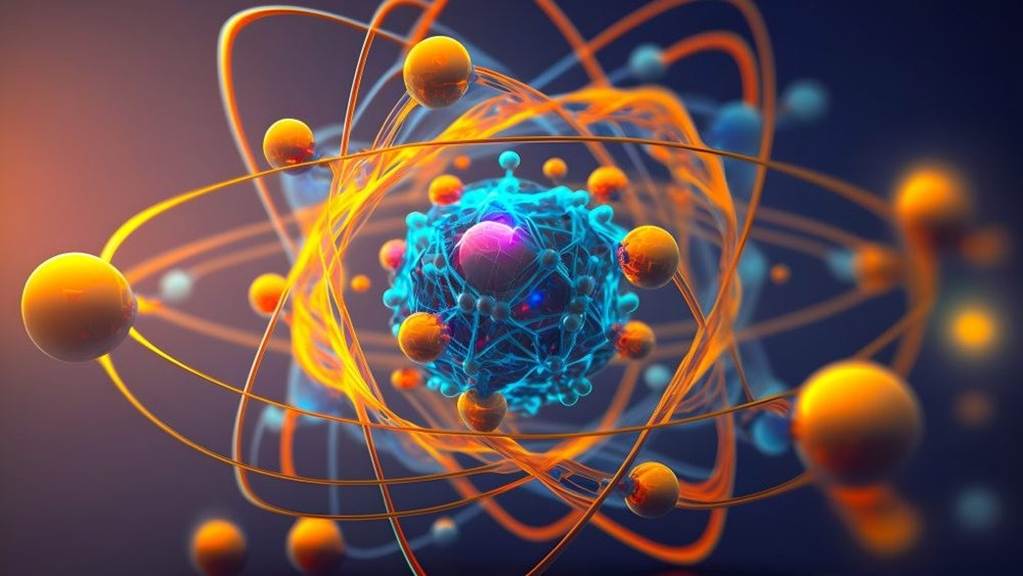
First atoms, hydrogen and helium atoms begin
forming through recombination. Atoms are the basic particles of the chemical elements and the fundamental building blocks of matter. An atom consists of a nucleus of protons and generally neutrons, surrounded by an electromagnetically bound swarm of electrons. The chemical elements are distinguished from each other by the number of protons that are in their atoms. For example, any atom that contains 11 protons is sodium, and any atom that contains 29 protons is copper. Atoms are extremely small, a human hair is about a million carbon atoms wide. Atoms are smaller than the shortest wavelength of visible light, which means humans cannot see atoms with conventional microscopes.
|
|
13,400,000,000 Cosmic microwave background, radiation decouples
from matter; the universe becomes transparent to light In the early universe, high temperatures resulted in a
thermal radiation field. As the universe expanded, this temperature dropped,
with each photon being redshifted to longer wavelengths. The CMB's discovery
in 1965 is considered a key piece of evidence supporting the Big Bang theory.
According to the Big Bang model, the radiation field should be isotropic,
meaning the same in every direction. Precise measurements by the Cosmic Background Explorer (COBE) satellite determined the spectrum to be characteristic of a blackbody at 2.735 K. The Wilkinson Microwave Anisotropy Probe (WMAP), launched in 2001, observed the fluctuations seen by COBE in greater detail and with more sensitivity. WMAP's data showed temperature variations caused by sound waves in the early universe and determined the universe's age.
|
|
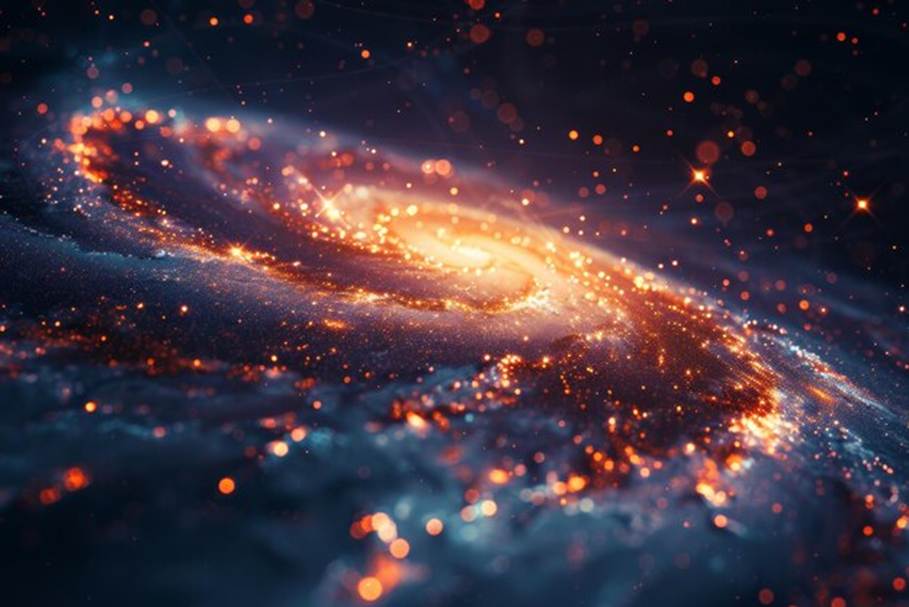
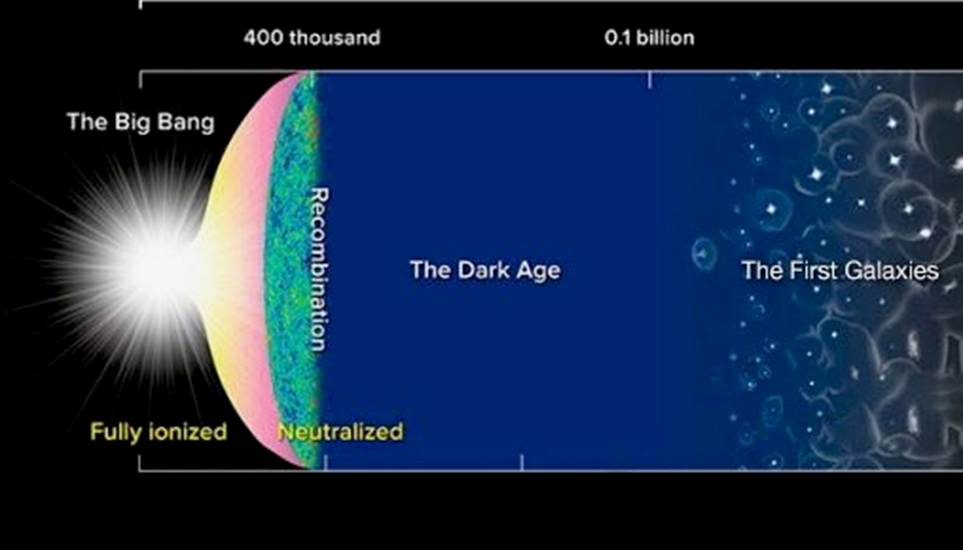
13,200,000,000 Dark ages begin, the universe is dark and starless
after the cosmic microwave background emission The cosmic dark ages describe a phase in the early universe during which stars or galaxies had not yet formed, and the universe consisted of neutral hydrogen gas that absorbed light. This period concluded when the first stars formed, ionizing the hydrogen and enabling light to move through space, thus ending the dark ages.
|
|
13,000,000,000 First stars, massive stars ignite, ending the
cosmic dark ages. For a star to form, you need a cloud of gas that can
collapse under its own gravity. As the gas collapses, it heats up. If the gas
can cool efficiently, gravity can continue to compress it until nuclear
fusion ignites at the core, creating a star. Initially, the universe contained only hydrogen and helium. Without heavier elements (metals), gas clouds cooled inefficiently and formed large masses, leading to massive Population III stars made from pure primordial gas. Unlike modern stars, which contain recycled metals that aid in cooling and influence their development, these early stars lacked heavy elements and differed greatly from stars like our Sun.
|
12,800,000,000
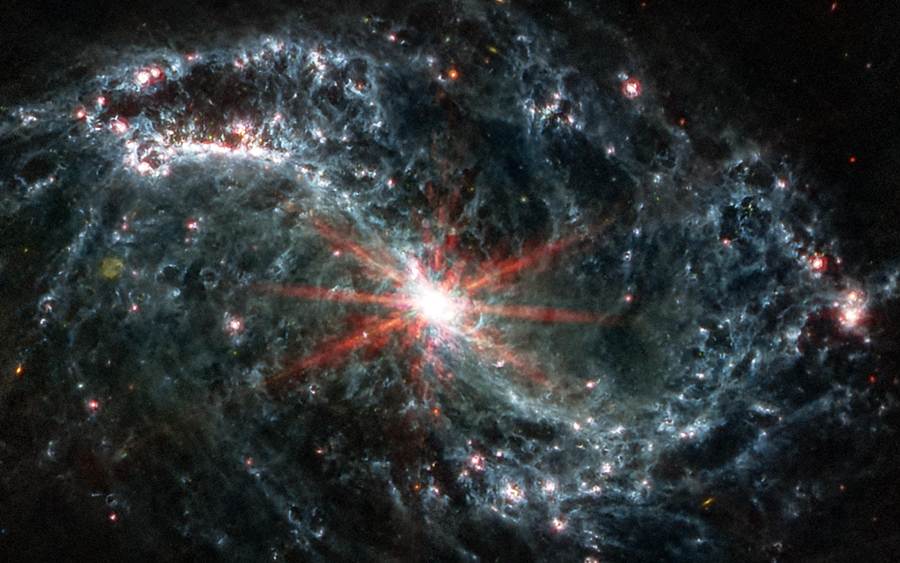
First galaxies, gravity pulls matter together into
the first galaxies The first galaxies were different from the grand spiral
and elliptical galaxies we see today. They were smaller, less massive, and
often irregular in shape. These were the protogalaxies, the seeds from which
modern galaxies grew. Many of the earliest galaxies were only a few thousand
light-years across (compared to the Milky Way’s 100,000 light-years). They
contained massive stars that lived fast and died young, constantly reshaping
their environments with powerful winds and supernova explosions. These early galaxies merged frequently. Gravity pulled them together into larger and larger systems, growing into the massive galaxies we observe in the nearby universe. Over billions of years, these mergers led to the formation of spiral galaxies, like the Milky Way, and giant elliptical galaxies found in galaxy clusters.
|
12,500,000,000
Reionization ends, starlight reionizes the universe’s
hydrogen gas, making space more transparent As the first stars and galaxies formed, their ultraviolet light began ionizing the universe's neutral hydrogen gas—a process known as reionization. This gradual transformation made the cosmos transparent, allowing light to travel through space. Galaxies and quasars were key drivers of this change, emitting energetic photons that ionized the intergalactic medium and cleared the way for starlight.
|
11,500,000,000
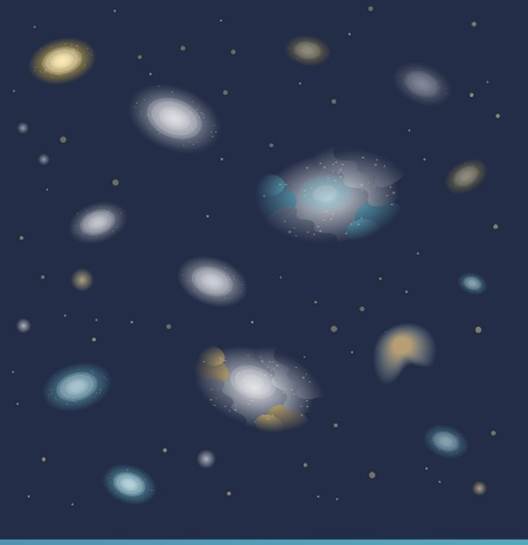
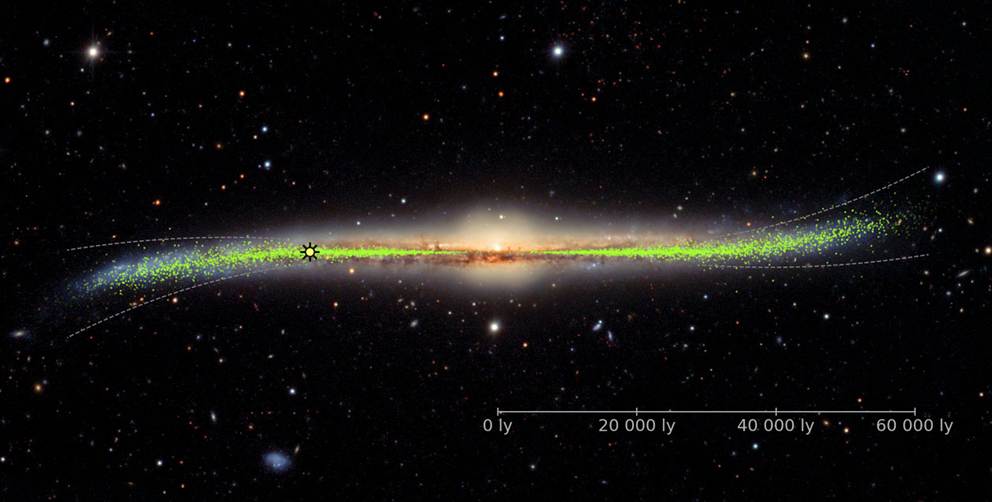
Milky way disk forms, the disk of our galaxy forms
from merging protogalaxies The part of the Milky Way containing the Sun is the disk,
which is a thick platter of stars, gas, and dust about 100,000 light-years
across. The large spiral system consisting of several hundred
billion stars, one of which is the Sun. Although Earth lies well within the
Milky Way Galaxy, astronomers do not have as complete an understanding of its
nature as they do of some external star systems. A thick layer of
interstellar dust obscures much of the Galaxy from scrutiny by optical
telescopes, and astronomers can determine its large-scale structure only with
the aid of radio and infrared telescopes, which can detect the forms of
radiation that penetrate the obscuring matter.
|
10,000,000,000
Star formation peak, the universe reaches its peak
rate of star birth Although the Universe was born without any stars within
it, the collapse of gas clouds caused the star-formation rate to increase
during the early part of cosmic history. About 3 billion years after the
start of the hot Big Bang, the star-formation rate reached its peak, and has
been declining ever since. The gas content in galaxies indicates their potential for star formation, as the gas fraction reflects how much matter is available for forming stars. Gas gets used up when new stars form and can be lost through supernovae or winds, but it may also be replenished from the intergalactic medium. These processes are well-studied in nearby galaxies. However, it's harder to determine the gas fraction in galaxies during peak star formation epochs because observing carbon monoxide, a common tracer, becomes challenging at great distances due to faint signals and decrease in the frequency and photon energy, of electromagnetic radiation (redshift). moving key wavelengths out of current observational range.
|
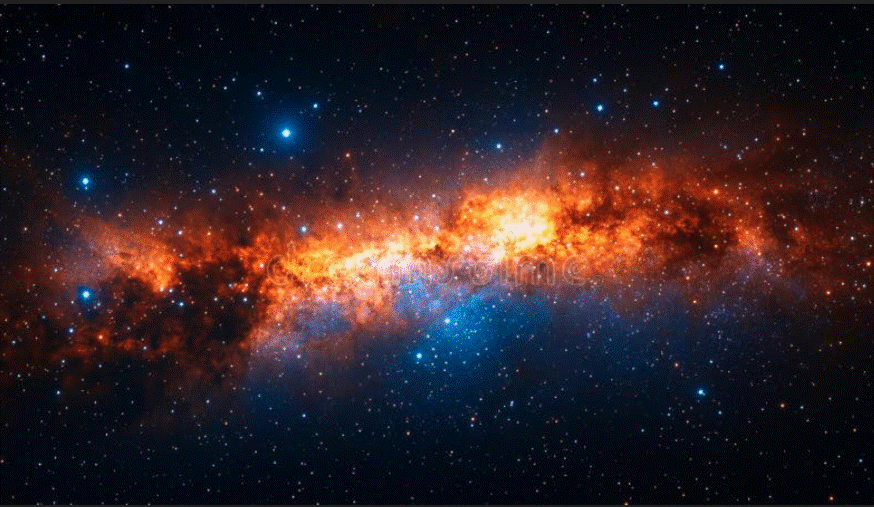
9,200,000,000
Solar system cloud, a gas cloud begins collapsing
to form our solar system Very slow gravitational collapse of a giant molecular cloud. Most of the collapsing mass collected in the center, forming the Sun, while the rest flattened into a protoplanetary disk out of which the planets, moons, asteroids, and other small Solar System bodies formed.
|
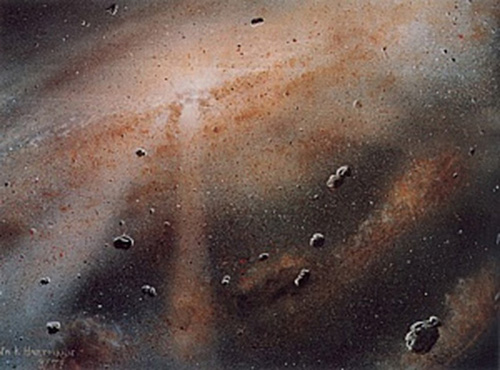
4,600,000,000
Sun forms, the sun ignites through nuclear fusion
at the heart of the solar system A distant star collapsed, creating a supernova explosion,
which disrupted the dust cloud and caused it to pull together. This formed a
spinning disc of gas and dust, known as a solar nebula. The faster the cloud
spun, the more the dust and gas became concentrated at the center, further
fueling the speed of the nebula. Over time, the gravity at the center of the
cloud became so intense that hydrogen atoms began to move more rapidly and
violently. The hydrogen protons began fusing, forming helium and releasing
massive amounts of energy. This led to the formation of the star that is the
center point of our solar system—the sun. The sun is at the heart of our
solar system, a massive star whose gravitational pull keeps a slew of
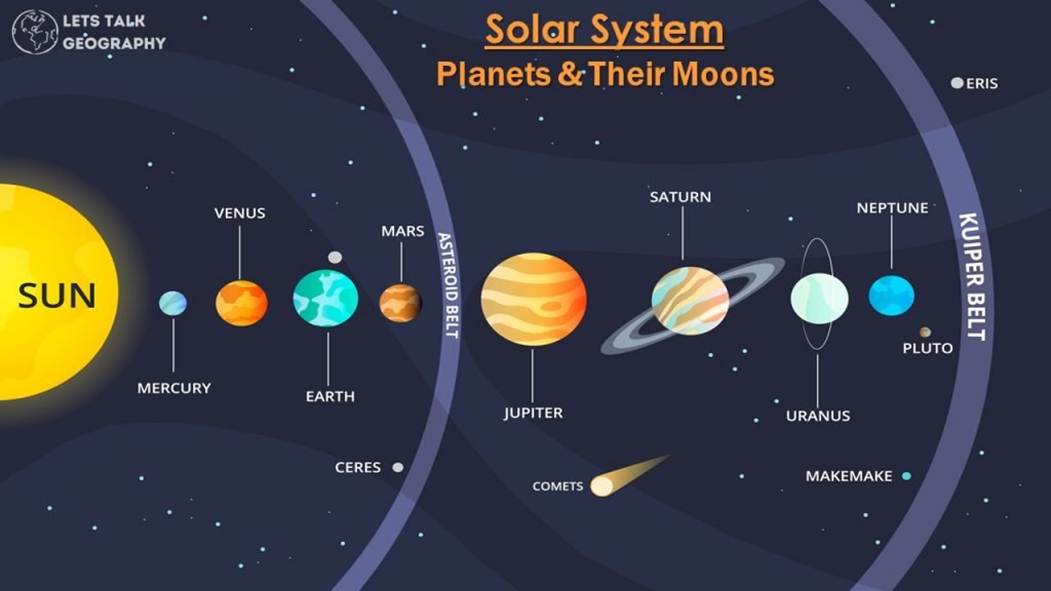
planets, dwarf planets (such as Pluto), comets, and meteoroids orbiting it. It is a massive, nearly perfect sphere of hot plasma,
heated to incandescence by nuclear fusion reactions in its core, radiating
the energy from its surface mainly as visible light and infrared radiation
with 10% at ultraviolet energies. The sun lies at the heart of the solar system, where it is
by far the largest object. It holds 99.8% of the solar system's mass and is
roughly 109 times the diameter of the Earth — about one million Earths could
fit inside the sun. The surface of the sun is about 10,000 degrees Fahrenheit
hot, while temperatures in the core reach more than 27 million F, driven by
nuclear reactions. One would need to explode 100 billion tons of dynamite
every second to match the energy produced by the sun. The sun is one of more than 200 billion stars in the Milky Way. It orbits some 25,000 light-years from the galactic core, completing a revolution once every 250 million years or so.
|
4,500,000,000
Earth forms, from accreting rocky debris around the
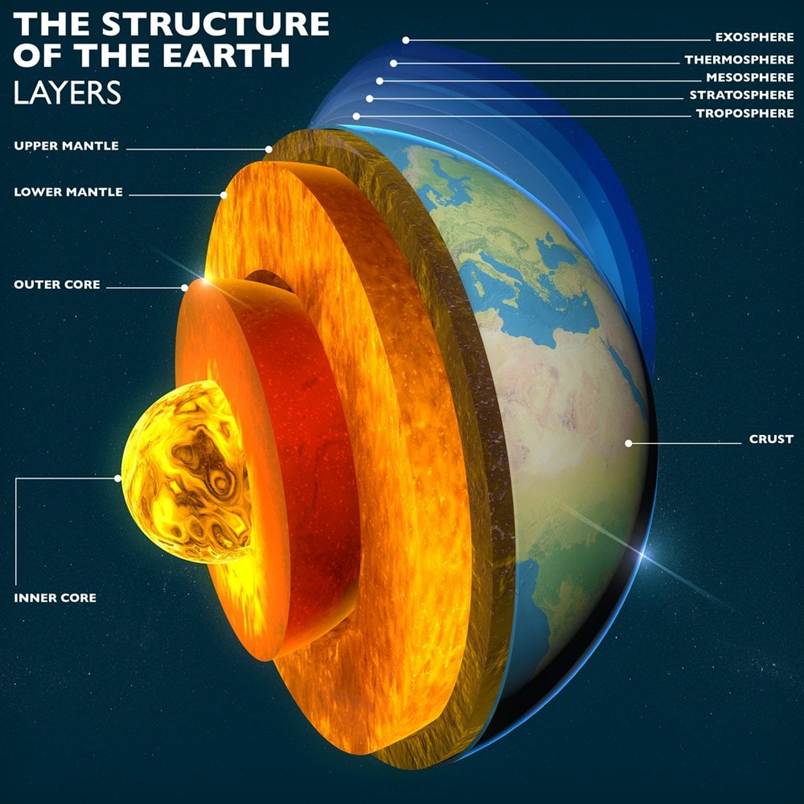
young sun Earth's rocky core formed first, with heavy elements
colliding and binding together. Dense material sank to the protoplanet's
center while lighter material built up the crust. Earth's magnetic field is
thought to have likely formed around this time. The flow of the mantle beneath Earth's crust causes plate
tectonics, the movement of the large plates of rock on the planet's surface.
Collisions and friction gave rise to mountains and volcanoes, which began to
spew gases. When Earth first formed it had barely any atmosphere. Its
atmosphere began to form as the planet started to cool and gravity captured
gases from Earth's volcanoes. While the population of comets and asteroids passing
through the inner solar system is sparse today, they were more abundant when
the planets and sun were young. Collisions between these cosmic bodies likely
deposited much of the water on Earth's surface. Our planet lies in what is known as the Goldilocks zone, a region surrounding a star that is close enough for liquid water to exist on a planet's surface, with water neither freezing nor evaporating. Many scientists think that being in this zone, and the presence of liquid water, plays a key role in the existence of life.
|
4,400,000,000
Moon forms, a giant impact creates the moon from
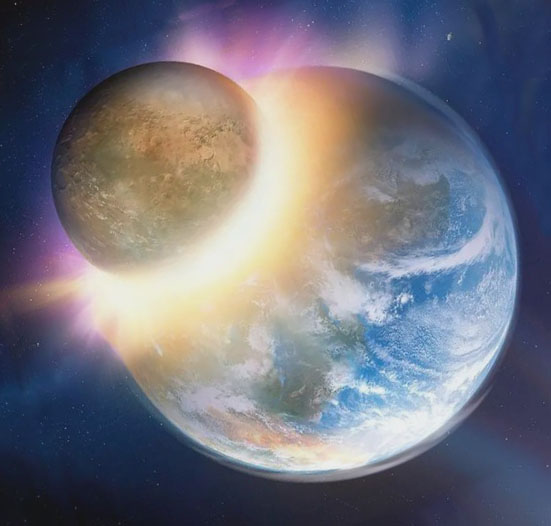
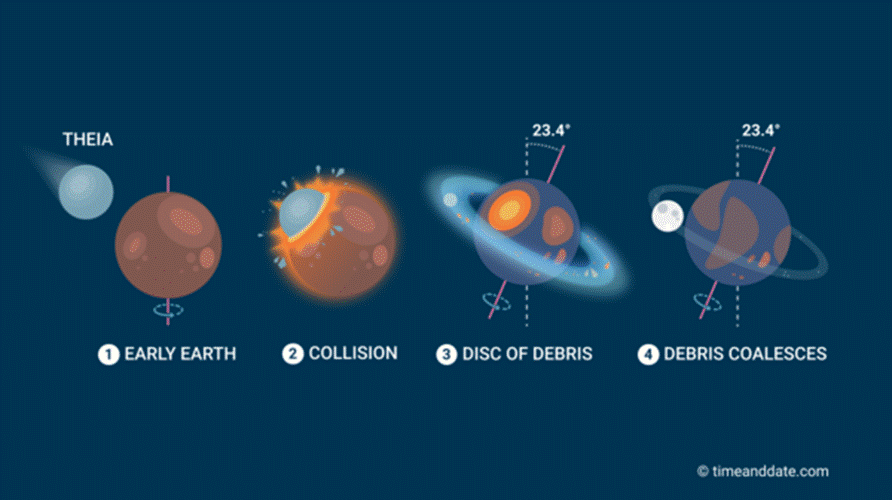
earth’s ejected material Early in its evolution, Earth suffered an impact by a large body that catapulted pieces of the young planet's mantle into space. Gravity pulled many of these pieces together to form the moon, which took up orbit around its creator.
|