Home
About
Links
Hobbycraft
Photos
Downloads
1776
|
Declaration
of Independence was
officially adopted by the Continental Congress on July 4, 1776. However, the
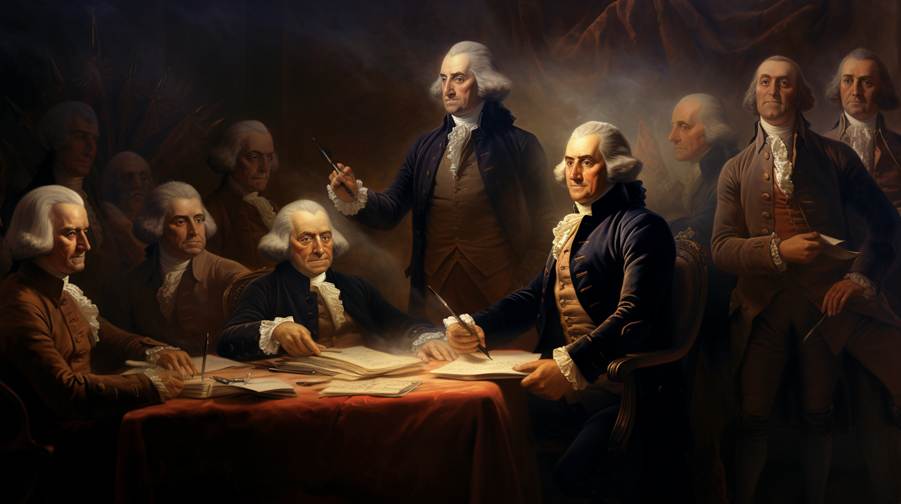
signing of the document took place later, primarily on August 2, 1776. The signing occurred at Independence Hall in Philadelphia. Initially, 56 delegates signed the document, with John Hancock's
signature being the most prominent. The Declaration was drafted by a committee led by Thomas
Jefferson, with input from John Adams and Benjamin Franklin. The document
articulated the colonies' reasons for seeking independence from British rule. The signing of the Declaration is a significant event in
American history, symbolizing the birth of the United States as an
independent nation.
1777 The
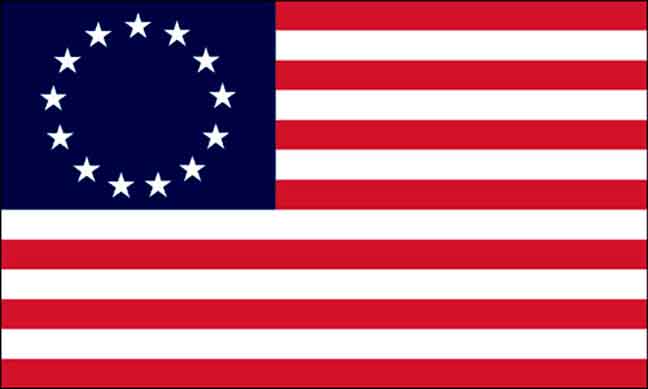
origin of the U.S. flag is that
Betsy Ross, an American upholsterer living in Philadelphia during the
Revolutionary War, created the first flag at the behest of George Washington Betsy was a widow struggling to run her own upholstery business.
Upholsterers in colonial America not only worked on furniture but did all
manner of sewing work, which for some included making flags. According to
Betsy, General Washington showed her a rough design of the flag that included
a six-pointed star. Betsy, a standout with the scissors, demonstrated how to
cut a five-pointed star in a single snip. Impressed, the committee entrusted
Betsy with making the first flag. Historians aren’t sure that ever happened,
however. The source for Ross’ involvement came from her own family, nearly a
century after Ross reportedly created the flag. Apart from her descendant’s
account, no evidence suggests that Ross sewed the first flag. Instead, some
historians think Francis Hopkinson, a signer of the Declaration of
Independence and designer of other seals for U.S. government departments, is
likely the first flag’s creator. Evidence exists that Hopkinson sought payment for the design of
the “flag of the United States of America” (he thought a “Quarter Cask of the
Public Wine” ought to do it). Although Hopkinson was denied payment, Congress
approved his flag on June 14, 1777 with the passage of the Flag Act, which
states “the flag of the thirteen United States be thirteen stripes, alternate
red and white; that the union be thirteen stars, white in a blue field,
representing a new constellation.” The colors themselves represent valor
(red), purity (white), and vigilance (blue).
Each star and stripe represented one of the thirteen Colonies,
united nearly one year earlier by the Declaration of Independence. The
thirteen Colonies are listed below with the date that each ratified the
Constitution and became a State. (1st) Delaware, December 7, 1787 (2nd) Pennsylvania,
December 12, 1787 (3rd) New Jersey,
December 18, 1787 (4th) Georgia,
January 2, 1788 (5th) Connecticut,
January 9, 1788 (6th) Massachusetts,
February 6, 1788 (7th) Maryland, April
28, 1788 (8th) South Carolina,
May 23, 1788 (9th) New Hampshire,
June 21, 1788 (10th) Virginia, June
25, 1788 (11th) New York, July
25, 1788 (12th) North
Carolina, November 21, 1789 (13th) Rhode Island, May 29, 1790 Throughout the years, the flag has undergone 26 small changes in
order to add new stars for new states joining the union. The first change
came in 1795, with the addition of Vermont and Kentucky (which added two
extra stripes as well). In June 1813, Major George Armistead arrived in
Baltimore, Maryland, to take command of Fort McHenry, built to guard the
water entrance to the city. Armistead commissioned Mary Pickersgill, a
Baltimore flag maker, to sew two flags for the fort: a smaller storm flag (17
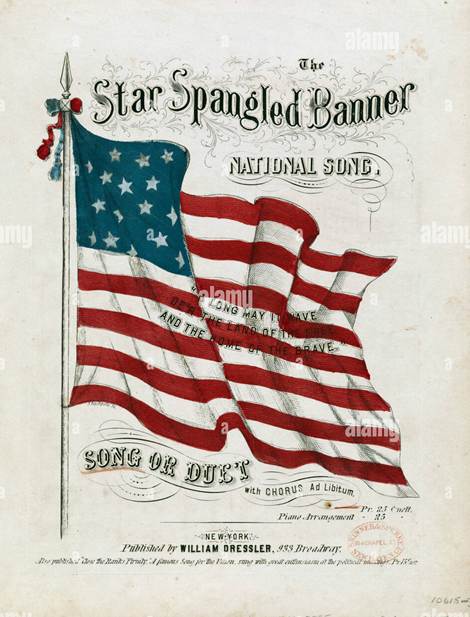
by 25 ft) and a larger garrison flag (30 by 42 ft). The larger of these two flags would become known as the
“Star-Spangled Banner.” Pickersgill stitched it from a combination of dyed
English wool bunting (red and white stripes and blue union) and white cotton
(stars).and this version is what’s known to history as the Star-Spangled
Banner, the flag that inspired Francis Scott Key to write the song that would
become our national anthem, is among the most treasured artifacts in the
collections of the Smithsonian’s National Museum of American History in Washington,
D.C.
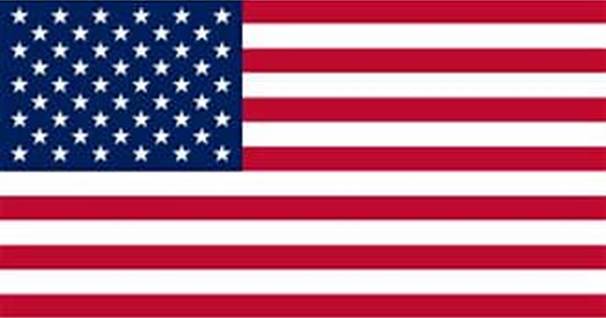
The last canton edit came on August 21, 1959, when President
Eisenhower issued Executive Order 10834, establishing today’s 50-star flag
following Hawaii’s statehood.
|


1786
|
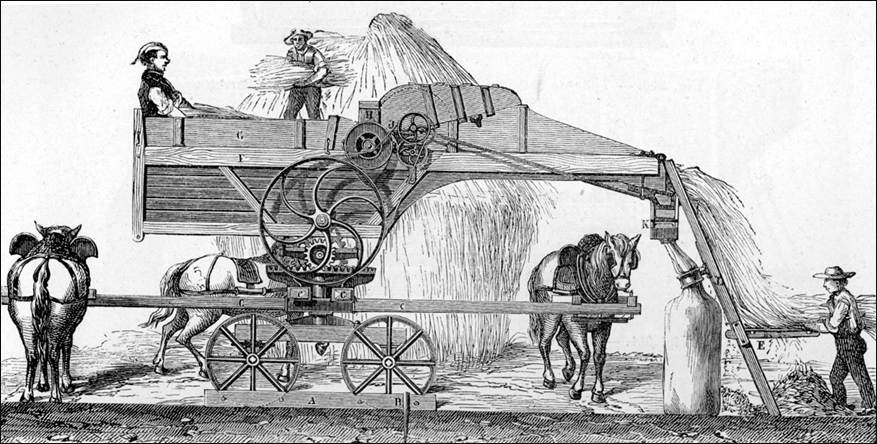
First
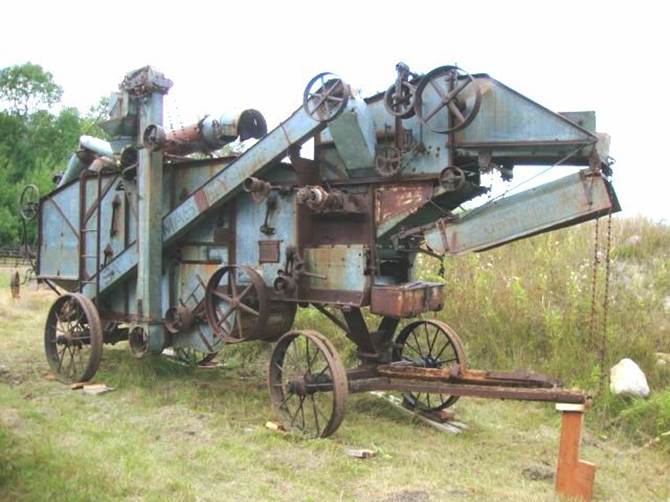
threshing machine, a
piece of farm equipment that separates grain seed from the stalks and husks. It
does so by beating the plant to make the seeds fall out. Before such machines
were developed, threshing was done by hand with flails: such hand threshing
was very laborious and time-consuming, taking about one-quarter of
agricultural labor by the 18th century.
|

1789
|
George
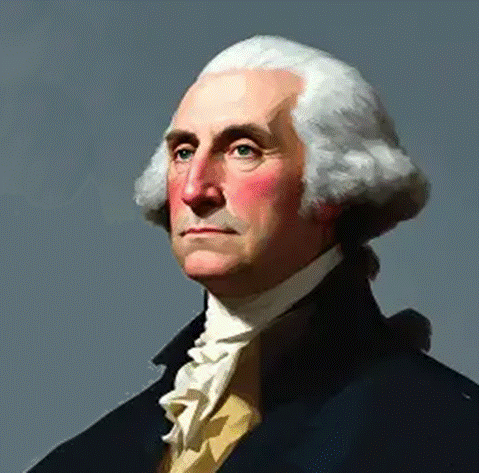
Washington elected first president, from 1789 to 1797. As commander of the Continental Army, Washington led Patriot
forces to victory in the American Revolutionary War against the British
Empire. He is commonly known as the Father of the Nation for his role in
bringing about American independence. Born in the Colony of Virginia February 22, 1732, He was the
first of six children of Augustine and Mary Ball Washington. His father was a
“justice of the peace” and a prominent public figure who had four additional
children from his first marriage to Jane Butler. Washington was not close to
his father and rarely mentioned him in later years; he had a fractious
relationship with his mother. Among his siblings, he was particularly close
to his older half-brother Lawrence.
Washington became commander of the Virginia Regiment during the
French and Indian War (1754–1763). He was subsequently elected to the
Virginia House of Burgesses and opposed measures implemented by the British
Crown affecting American colonists. With the start of the American
Revolutionary War in 1775, Washington was appointed commander-in-chief of the
Continental Army. He led an under-resourced force against British troops,
achieving victory at the Siege of Boston in March 1776, followed by a
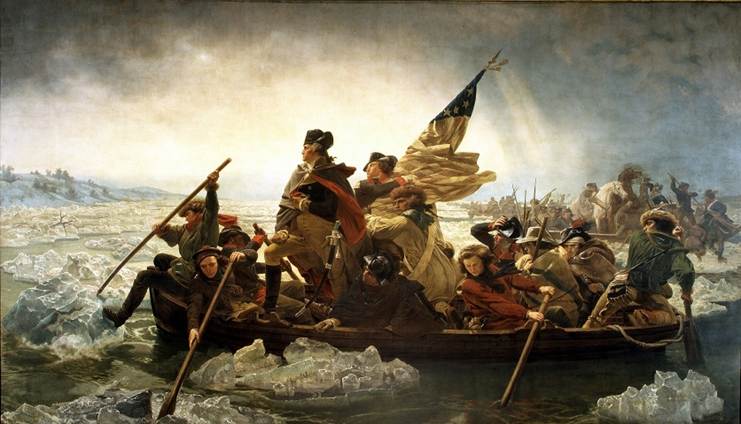
withdrawal from New York City in November. Later that year, he crossed the
Delaware River and secured victories at Trenton and Princeton, but
experienced defeats at Brandywine and Germantown. Throughout the conflict,
Washington encountered criticism, low troop morale, and shortages of
supplies. In 1781, he led a joint French and American force to success at
Yorktown, which contributed to the British recognition of U.S. independence
in the Treaty of Paris (1783). Washington later presided over the
Constitutional Convention in 1787, where the current U.S. Constitution was
drafted. Washington was unanimously elected the first U.S. president in 1788
and 1792, establishing a strong national government and maintaining
impartiality amid cabinet rivalries. He adopted a neutral stance during the
French Revolution and supported the Jay Treaty. Washington set lasting
presidential precedents such as republicanism, peaceful power transition, use
of "Mr. President", and the two-term limit. His farewell address
warned against regionalism, partisanship, and foreign influence. At Mount
Vernon, he owned slaves but arranged for their eventual emancipation in his
will. Washington is widely regarded as one of America's greatest
presidents. He is memorialized extensively, including in the names of the
nation’s capital and the State of Washington.
|

1791
|
The
Bill of Rights approved, the first ten amendments to the United
States Constitution, which guarantee essential rights and freedoms to
individuals, such as freedom of speech, religion, and the right to bear arms.
It was created to address concerns about the lack of specific protections for
individual liberties in the original Constitution. Amendment I Congress shall make no law respecting an establishment of
religion, or prohibiting the free exercise thereof; or abridging the freedom
of speech, or of the press; or the right of the people peaceably to assemble,
and to petition the government for a redress of grievances. Amendment II A well-regulated militia, being necessary to the security
of a free state, the right of the people to keep and bear arms, shall not be
infringed. (NOTE: The ‘Militia’ are the Citizens, which shall be
‘Well-Regulated’ when called up in defense of the Country and Constitution,
and as it very clearly states: “The Right of The People to Keep And Bear
Arms… SHALL NOT BE INFRINGED”!—The Second Amendment Protects the First, and
all the rest of them!) Amendment III No soldier shall, in time of peace be quartered in any
house, without the consent of the owner, nor in time of war, but in a manner
to be prescribed by law. Amendment IV The right of the people to be secure in their persons,
houses, papers, and effects, against unreasonable searches and seizures,
shall not be violated, and no warrants shall issue, but upon probable cause,
supported by oath or affirmation, and particularly describing the place to be
searched, and the persons or things to be seized. Amendment V No person shall be held to answer for a capital, or
otherwise infamous crime, unless on a presentment or indictment of a grand
jury, except in cases arising in the land or naval forces, or in the militia,
when in actual service in time of war or public danger; nor shall any person
be subject for the same offense to be twice put in jeopardy of life or limb;
nor shall be compelled in any criminal case to be a witness against himself,
nor be deprived of life, liberty, or property, without due process of law; nor
shall private property be taken for public use, without just compensation. Amendment VI In all criminal prosecutions, the accused shall enjoy the
right to a speedy and public trial, by an impartial jury of the state and
district wherein the crime shall have been committed, which district shall
have been previously ascertained by law, and to be informed of the nature and
cause of the accusation; to be confronted with the witnesses against him; to
have compulsory process for obtaining witnesses in his favor, and to have the
assistance of counsel for his defense. Amendment VII In suits at common law, where the value in controversy
shall exceed twenty dollars, the right of trial by jury shall be preserved,
and no fact tried by a jury, shall be otherwise reexamined in any court of
the United States, than according to the rules of the common law. Amendment VIII Excessive bail shall not be required, nor excessive fines
imposed, nor cruel and unusual punishments inflicted. Amendment IX The enumeration in the Constitution, of certain rights,
shall not be construed to deny or disparage others retained by the people. Amendment X The powers not delegated to the United States by the
Constitution, nor prohibited by it to the states, are reserved to the states
respectively, or to the people.
|
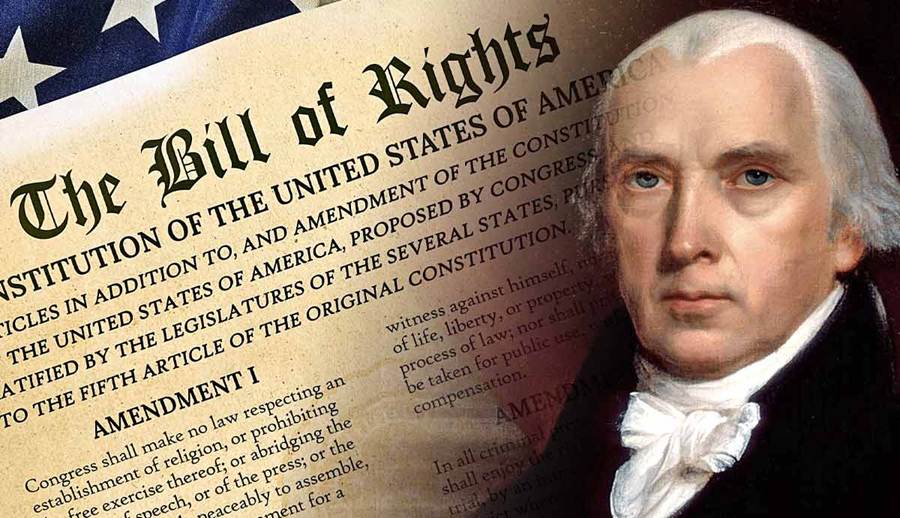
James Madison principal author of the amendments

1803 🌍 950 million
|
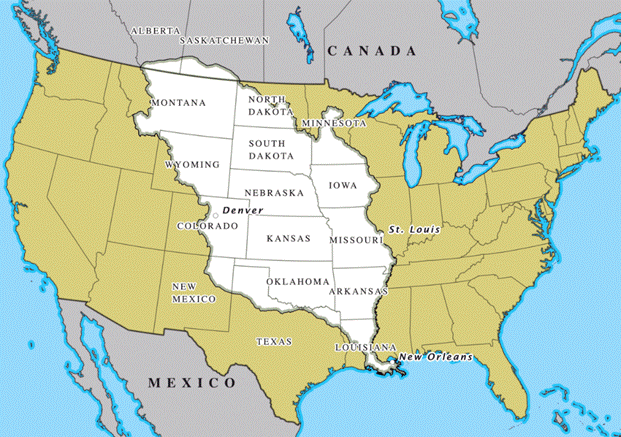
Louisiana
Purchase refers
to the United States' acquisition of Louisiana territory from France in 1803 for
$15 million. The purchase included about 828,000 square miles, though France
controlled only a small part, as most of the land was inhabited by Native
Americans; essentially, the U.S. gained the right to acquire these lands
exclusively. France controlled Louisiana from 1682 until it ceded the
territory to Spain in 1762. Napoleon regained Louisiana in 1800, trading land
in Tuscany to rebuild a French colonial presence in North America. However,
after failing to quell a revolt in Saint-Domingue and facing war with the UK,
Napoleon considered selling Louisiana to the US. President Thomas Jefferson aimed to acquire Louisiana,
particularly New Orleans for its access to the Mississippi River. He sent
James Monroe and Robert R. Livingston to negotiate with the French, who
offered the entire territory. Despite Federalist opposition, Jefferson and
Secretary of State James Madison secured congressional approval and funding
for the Louisiana Purchase. The Louisiana Purchase extended United States sovereignty across
the Mississippi River, nearly doubling the nominal size of the country. The
purchase included land from fifteen present U.S. states and two Canadian
provinces, including the entirety of Arkansas, Missouri, Iowa, Oklahoma,
Kansas, and Nebraska; large portions of North Dakota and South Dakota; the
area of Montana, Wyoming, and Colorado east of the Continental Divide; the
portion of Minnesota west of the Mississippi River; the northeastern section
of New Mexico; northern portions of Texas; New Orleans and the portions of
the present state of Louisiana west of the Mississippi River; and small
portions of land within Alberta and Saskatchewan. At the time of the
purchase, the territory of Louisiana's non-native population was around
60,000 inhabitants, of whom half were enslaved Africans. The western borders
of the purchase were later settled by the 1819 Adams–Onís Treaty with Spain,
while the northern borders of the purchase were adjusted by the Treaty of
1818 with the British.
1826 The
invention of the camera revolutionized
how we capture memories, document events, and record history. Joseph
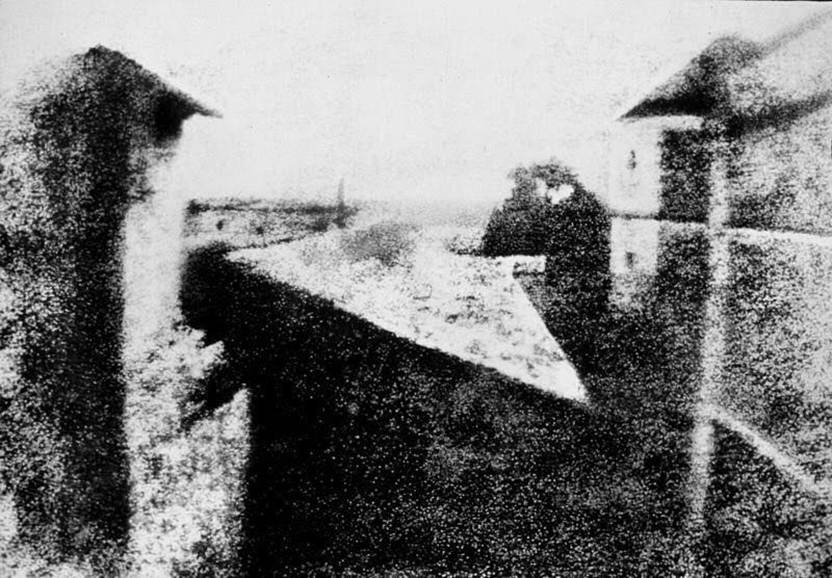
Nicéphore Niépce took the first permanent photograph in 1826, View from the
Window at Le Gras," from his estate in France. He “dissolved
light-sensitive bitumen in oil of lavender” then applied a coating of the
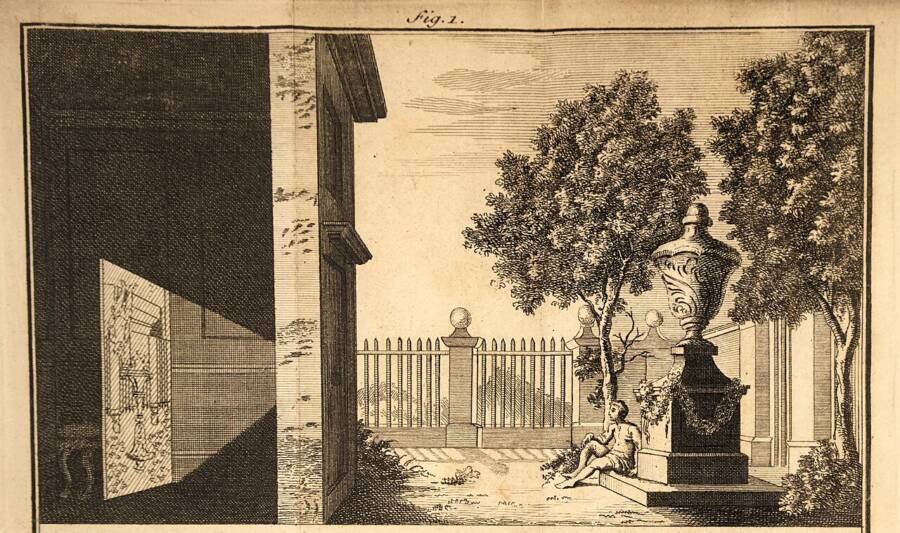
mixture over a pewter plate. Next, Niépce slid the plate into a
camera obscura. This technology had existed in one form or another for
centuries and is basically a dark space with a small hole. As light pours
through the hole, it projects a reverse image of the scene outside on the
interior wall.
With the pewter plate in place, he moved the camera obscura near
a second-story window at his home in Saint-Loup-de-Varennes, France. Then, he
waited Eight hours later, Niépce found that his experiment had worked.
After a long exposure to sunlight, the plate yielded an impression of the
courtyard, outbuildings, and trees outside. It didn’t look like much, but
“View from the Window at Le Gras” (named for Niépce’s estate) was a
remarkable thing. It was the first photo ever taken.
Camera technology has evolved continuously since then—from bulky
film cameras to compact digital devices. Photography has greatly impacted
art, journalism, and personal expression, enabling people to preserve and
share moments in real time.
|