Home
About
Links
Hobbycraft
Photos
Downloads
|
1861 American
civil war, between the Union
("the North") and the Confederacy ("the South"), which
was formed by states that had seceded from the Union. The central conflict
leading to war was a dispute over whether slavery should be permitted to
expand into the western territories, leading to more slave states, or be
prohibited from doing so, which many believed would place slavery on a course
of ultimate extinction. Decades
of controversy over slavery came to a head when Abraham Lincoln, who opposed
slavery's expansion, won the 1860 presidential election. Seven Southern slave
states responded to Lincoln's victory by seceding from the United States and
forming the Confederacy. The Confederacy seized US forts and other federal
assets within its borders. The war began on April 12, 1861, when the
Confederacy bombarded Fort Sumter in South Carolina. A wave of enthusiasm for
war swept over the North and South, as military recruitment soared. Four more
Southern states seceded after the war began and, led by its president,
Jefferson Davis, the Confederacy asserted control over a third of the US
population in eleven states. Four years of intense combat, mostly in the
South, ensued. During
1861–1862 in the western theater, the Union made permanent gains—though in
the eastern theater the conflict was inconclusive. The abolition of slavery
became a Union war goal on January 1, 1863, when Lincoln issued the
Emancipation Proclamation, which declared all slaves in rebel states to be
free, applying to more than 3.5 million of the 4 million enslaved people in
the country. To the west, the Union first destroyed the Confederacy's river
navy by the summer of 1862, then much of its western armies, and seized New
Orleans. The
successful 1863 Union siege of Vicksburg split the Confederacy in two at the
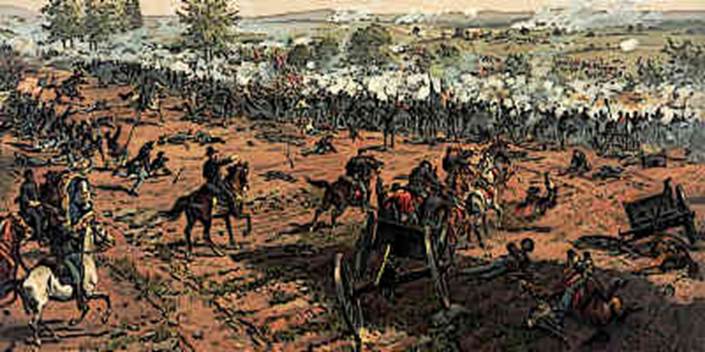
Mississippi River, while Confederate general Robert E. Lee's incursion north
failed at the Battle of Gettysburg. Western successes led to General Ulysses
S. Grant's command of all Union armies in 1864. Inflicting an ever-tightening
naval blockade of Confederate ports, the Union marshaled resources and
manpower to attack the Confederacy from all directions. This led to the fall
of Atlanta in 1864 to Union general William Tecumseh Sherman, followed by his
March to the Sea, which culminated in his taking Savannah. The last
significant battles raged around the ten-month Siege of Petersburg, gateway
to the Confederate capital of Richmond. The
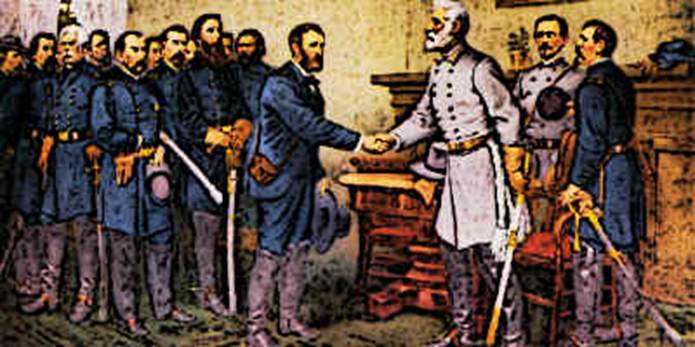
Confederates abandoned Richmond, and on April 9, 1865, Lee surrendered to
Grant following the Battle of Appomattox Court House, setting in motion the
end of the war By
the end of the war, much of the South's infrastructure had been destroyed.
The Confederacy collapsed, slavery was abolished, and four million enslaved
black people were freed. The war-torn nation then entered the Reconstruction
era in an attempt to rebuild the country, bring the former Confederate states
back into the United States, and grant civil rights to freed slaves. The war
is one of the most extensively studied and written about episodes in the
history of the United States. It remains the subject of cultural and
historiographical debate. Of continuing interest is the myth of the Lost
Cause of the Confederacy. The war was among the first to use industrial
warfare. Railroads, the electrical telegraph, steamships, the ironclad
warship, and mass-produced weapons were widely used. The war left an
estimated 700,000 soldiers dead, along with an undetermined number of
civilian casualties, making it the deadliest in American history. The
technology and brutality of the Civil War foreshadowed the coming world wars.
Federal
income tax was first introduced In order to help pay for its war
effort in the American Civil War, the United States government imposed its
first personal income tax, on August 5, 1861, as part of the Revenue Act of
1861. Tax rates were 3% on income exceeding $600 and less than $10,000, and
5% on income exceeding $10,000.[8] This tax was repealed and replaced by
another income tax in the Revenue Act of 1862 under the Revenue Act of 1861 to help pay for the Civil War. It
was renewed in later years and reformed in 1894 in the form of the
Wilson-Gorman tariff. This
imposed the first peacetime income tax. The rate was 2% on income over $4000,
which meant fewer than 10% of households would pay any. The purpose of the
income tax was to make up for revenue that would be lost by tariff
reductions. This was a controversial provision, and the law actually passed
without the signature of President Grover Cleveland. in 1909
Congress proposed the Sixteenth Amendment. This amendment reads as follows: The Congress shall have power to lay and collect taxes on
incomes, from whatever source derived, without apportionment among the
several States, and without regard to any census or enumeration. By February
1913, the required three-fourths of the states ratified the Sixteenth
Amendment, thus adding the amendment to the constitution. Later that
year, Congress enacted the Revenue Act of 1913. The tax ranged from 1% on
income exceeding $3,000 to 7% on incomes exceeding $500,000. This marked the
beginning of the modern income tax system in the United Sates.
|



|
1864 Abraham
Lincoln assassination attempt, mid-August,
Lincoln was heading to his cottage at the Soldiers' Home in Washington D.C.,
about 3 miles northeast of the White House. Lincoln was riding alone on his
horse, Old Abe, to the home at about 11 p.m. at night, deep in thought.
Between 1862 and 1864, Lincoln was known to spend the summer months at the
Soldiers' Home with his family, starting between mid-June and early July of
each year to escape the heat, and staying until early November. On
that night, John W. Nichols, a sentry of the property, was on duty, and was
stationed at the gate of the home. When Lincoln arrived at the foot of the
hill of the path to the Soldiers' Home, Nichols suddenly heard a rifle shot
in the distance, and shortly after, Lincoln appeared at the gate on his
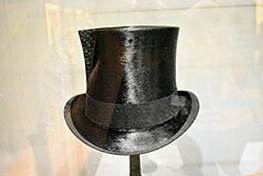
horse, missing his stovepipe hat. Nichols found that the hat had a
bullet-hole through it's crown.
|

|
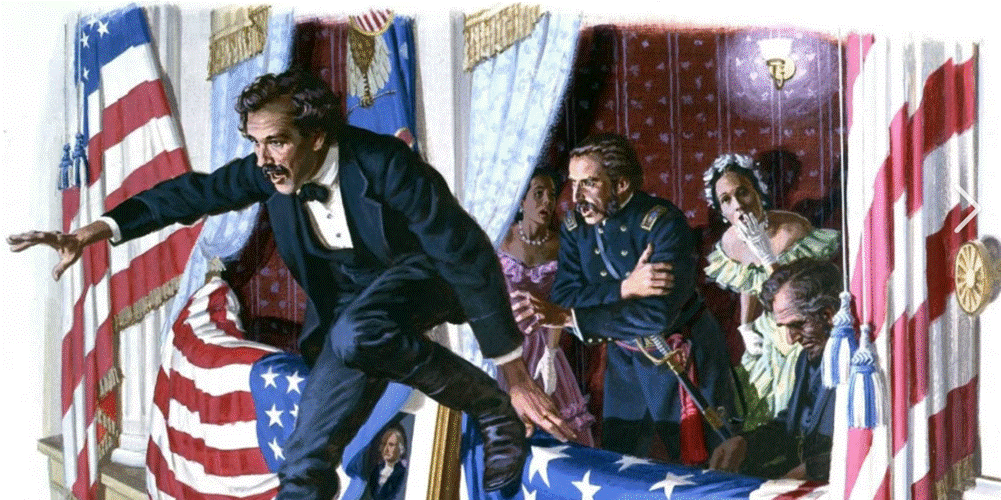
1865 Abraham
Lincoln is assassinated, by John Wilkes Booth
at Ford's Theatre in Washington, D.C. Booth shot Lincoln while he was
watching a play, and the president died the following morning.
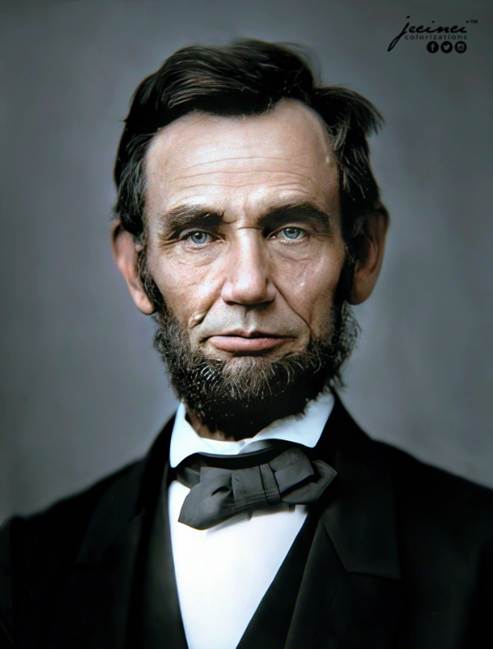
John Wilkes Booth escapes the theatre He
was the 16th president of the United States (1861–65), who preserved the
Union during the American Civil War and brought about the emancipation of
enslaved people in the United States. Lincoln
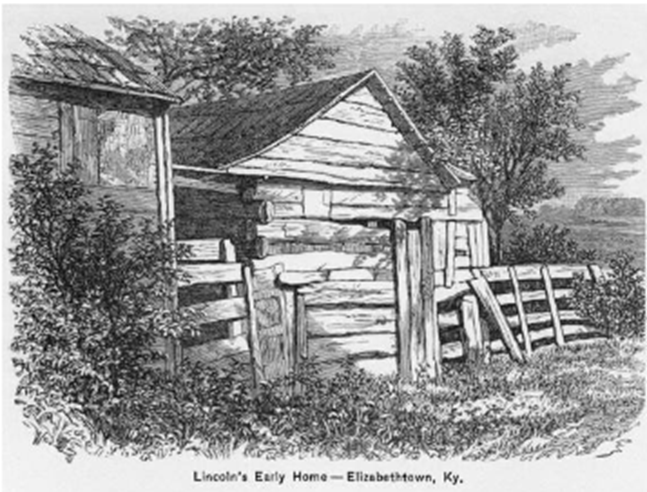
was born in a backwoods cabin 3 miles (5 km) south of Hodgenville, Kentucky,
and was taken to a farm in the neighboring valley of Knob Creek when he was
two years old. His earliest memories were of this home and, in particular, of
a flash flood that once washed away the corn and pumpkin seeds he had helped
his father plant.
His
father, Thomas Lincoln, was the descendant of a weaver’s apprentice who had
migrated from England to Massachusetts in 1637. Though much less prosperous
than some of his Lincoln forebears, Thomas was a sturdy pioneer. On June 12,
1806, he married Nancy Hanks. She has been described as “stoop-shouldered,
thin-breasted, sad,” and fervently religious. Thomas and Nancy Lincoln had
three children: Sarah, Abraham, and Thomas, who died in infancy. In
December 1816, faced with a lawsuit challenging the title to his Kentucky
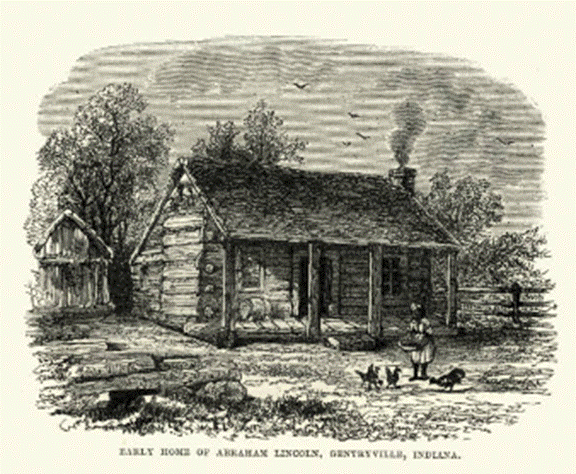
farm, Thomas Lincoln moved with his family to southwestern Indiana. There, as
a squatter on public land, he hastily put up a “half-faced camp”—a crude
structure of logs and boughs with one side open to the weather—in which the
family took shelter behind a blazing fire. Soon he built a permanent cabin,
and later he bought the land on which it stood.
Abraham
helped to clear the fields and to take care of the crops but early acquired a
dislike for hunting and fishing. In afteryears he recalled the “panther’s
scream,” the bears that “preyed on the swine,” and the poverty of Indiana
frontier life, which was “pretty pinching at times.” The
unhappiest period of his boyhood followed the death of his mother in the
autumn of 1818. As a ragged nine-year-old, he saw her buried in the forest,
then faced a winter without the warmth of a mother’s love. Fortunately,
before the onset of a second winter, Thomas Lincoln married Sarah Bush
Johnston, who moved from Kentucky to Indiana to make a family with Thomas
Lincoln. A widow with two girls and a boy of her own, she had energy and
affection to spare and ran the household with an even hand, treating both
sets of children as if she had borne them all, but she became especially fond
of Abraham, and he of her. He afterward referred to his stepmother as his
“angel mother.” In
March 1830 the Lincoln family undertook a second migration, this time to
Illinois, with Lincoln himself driving the team of oxen. Having just reached
the age of 21, he was about to begin life on his own. Six feet four inches
tall, he was rawboned and lanky but muscular and physically powerful. He was
especially noted for the skill and strength with which he could wield an ax.
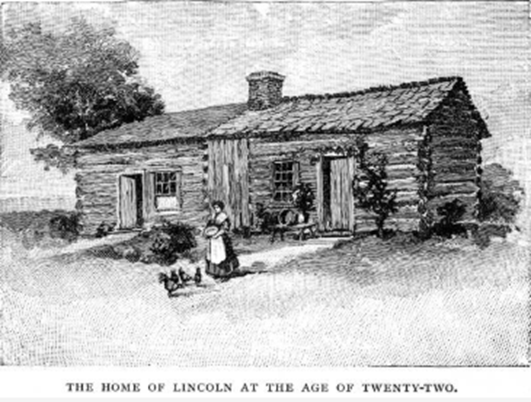
Built by Lincoln and his father on Goose
Nest Prairie, near Farmington, Illinois in 1831 He
spoke with a backwoods twang and walked in the long-striding, flat-footed,
cautious manner of a plowman. Good-natured though somewhat moody, talented as
a mimic and storyteller, he readily attracted friends. After
his arrival in Illinois, having no desire to be a farmer, Lincoln tried his
hand at a variety of occupations. As a rail-splitter, he helped to clear and
fence his father’s new farm. As a flatboatman, he made a voyage down the
Mississippi River to New Orleans, Louisiana. (This was his second visit to
that city, his first having been made in 1828, while he still lived in
Indiana.) Upon his return to Illinois he settled in New Salem, a village of
about 25 families on the Sangamon River. There he worked from time to time as
storekeeper, postmaster, and surveyor. With the coming of the Black Hawk War
(1832), he enlisted as a volunteer and was elected captain of his company.
Afterward he joked that he had seen no “live, fighting Indians” during the
war but had had “a good many bloody struggles with the mosquitoes.”
Meanwhile, aspiring to be a legislator, he was defeated in his first try and
then repeatedly reelected to the state assembly. He considered blacksmithing
as a trade but finally decided in favor of the law. Already having taught
himself grammar and mathematics, he began to study law books. In 1836, having
passed the bar examination, he began to practice law. The
next year he moved to Springfield, Illinois, the new state capital, which
offered many more opportunities for a lawyer than New Salem did.
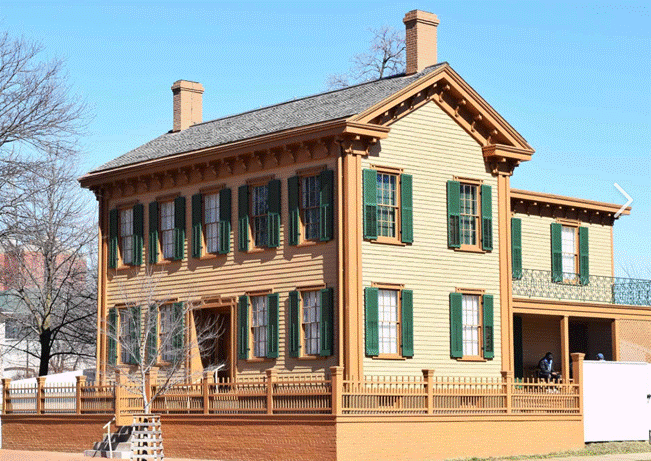
Lincoln’s home in Springfield At
first Lincoln was a partner of John T. Stuart, then of Stephen T. Logan, and
finally, from 1844, of William H. Herndon. Nearly 10 years younger than
Lincoln, Herndon was more widely read, more emotional at the bar, and
generally more extreme in his views. Yet this partnership seems to have been
as nearly perfect as such human arrangements ever are. Lincoln and Herndon
kept few records of their law business, and they split the cash between them
whenever either of them was paid. It seems they had no money quarrels. Within
a few years of his relocation to Springfield, Lincoln was earning $1,200 to
$1,500 annually, at a time when the governor of the state received a salary
of $1,200 and circuit judges only $750. He had to work hard. To keep himself
busy, he found it necessary not only to practice in the capital but also to
follow the court as it made the rounds of its circuit. Each spring and fall
he would set out by horseback or buggy to travel hundreds of miles over the
thinly settled prairie, from one little county seat to another. Most of the
cases were petty and the fees small. The
coming of the railroads, especially after 1850, made travel easier and
practice more remunerative. Lincoln served as a lobbyist for the Illinois
Central Railroad, assisting it in getting a charter from the state, and
thereafter he was retained as a regular attorney for that railroad. After
successfully defending the company against the efforts of McLean County to
tax its property, he received the largest single fee of his legal
career—$5,000. (He had to sue the Illinois Central in order to collect the fee.)
He also handled cases for other railroads and for banks, insurance companies,
and mercantile and manufacturing firms. In one of his finest performances
before the bar, he saved the Rock Island Bridge, the first to span the
Mississippi River, from the threat of the river transportation interests that
demanded the bridge’s removal. His business included a number of patent suits
and criminal trials. One of his most effective and famous pleas had to do
with a murder case. A witness claimed that, by the light of the moon, he had
seen Duff Armstrong, an acquaintance of Lincoln’s, take part in a killing.
Referring to an almanac for proof, Lincoln argued that the night had been too
dark for the witness to have seen anything clearly, and with a sincere and
moving appeal he won an acquittal. By
the time he began to be prominent in national politics, about 20 years after
launching his legal career, Lincoln had made himself one of the most
distinguished and successful lawyers in Illinois. He was noted not only for
his shrewdness and practical common sense, which enabled him always to see to
the heart of any legal case, but also for his invariable fairness and utter
honesty.
|