Home
About
Links
Hobbycraft
Photos
Downloads
|
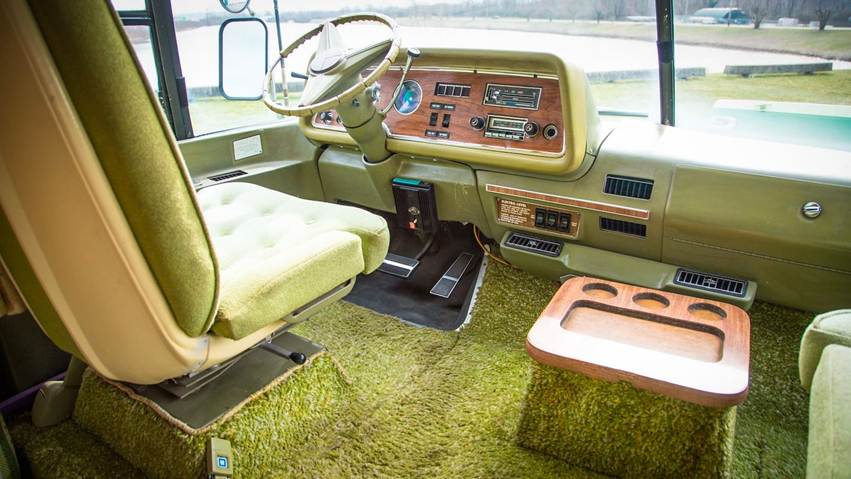
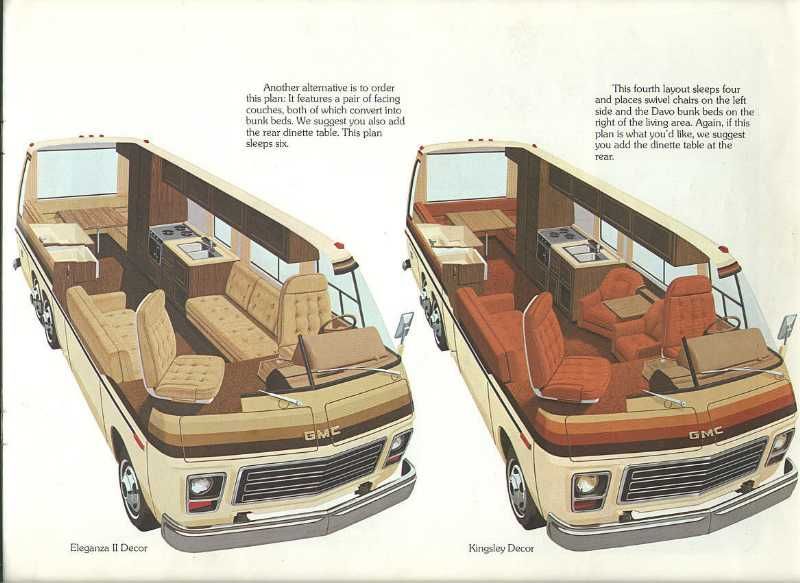
1973 GMC
Motorhome was manufactured as
the only complete motorhome built by a major auto/truck manufacturer. https://en.wikipedia.org/wiki/GMC_Motorhome
- External_links Manufactured in 23 and 26 foot lengths, the design was noted for
its front-wheel drive and its low profile, fully integrated body. In contrast to most motorhomes which were manufactured on
drivetrain-equipped frames supplied by a chassis manufacturer; GMC designed,
engineered, and built the entire vehicle, and in most cases the interiors,
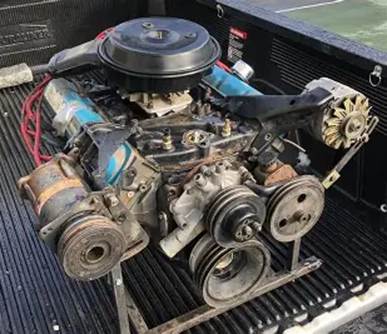
completely in-house. The motorhome had a front-wheel-drive transaxle, which GM called
the Unitized Power Package, originally used in the Oldsmobile Toronado and
Cadillac Eldorado with an Oldsmobile 455 cu in V8 from the Toronado.
In mid-1977 the engine was downsized to a 403 cu in V8. It used
the GM-designated Turbo-Hydramatic 425 automatic transmission, with a wide
roller chain drive to connect the output of the longitudinally-oriented
engine to the transmission. The final drive was connected directly to the
transmission, and power was fed to the front wheels using half-shafts, one of
which ran under the front portion of the engine. The engine was fueled with
regular gasoline stored in two 25-US-gallon (95 L) tanks. The GMC was equipped with front disc brakes and drums on all
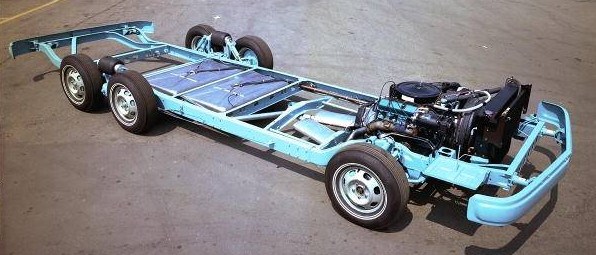
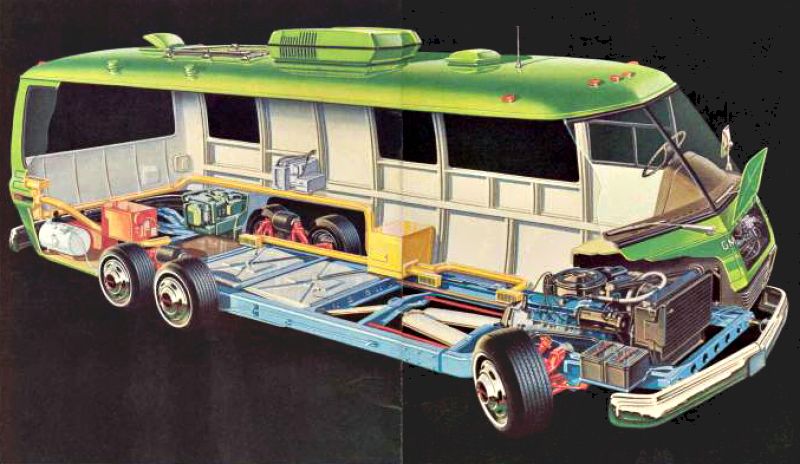
four rear wheels. The front-drive configuration eliminated the driveshaft and
rear differential and the solid axle found on most front-engined motorhomes.
As a result, the floor could be built with about 14 inches (36 cm) clearance
above the roadway. The floor was too low for a rear cross axle, and GM
designed the rear suspension as a tandem pair of wheels, mounted on bogies
that rode on pins attached to the sides of the low-profile frame. With the
exception of the wheel wells, the rear suspension does not intrude into the
living space. The rear bogies are suspended using a double-ended reversible
sleeve airbag that is pressurized by an automatic leveling system to maintain
the designed ride height. The leveling system can also be manually controlled
to level the coach at a campsite. The overall chassis design, from the use of
an existing GM E platform powertrain and a modified rear suspension, has been
considered an early ancestor of the crossover. The motorhomes were built in either 23-foot or 26-foot length,
with about 90% of the total production being the latter. The wheelbase from
the front wheels to the centerline of the rear tandem pairs is 140 inches for
the 23-foot coach and 160 inches for the 26-foot coach. All GMC Motorhomes
are 96 inches wide and about 9 feet tall including the usually-installed roof
air conditioner. Interior head room is 76 inches. Gross vehicle weight rating for the 23-foot coach was 10,500 pounds and 12,500 pounds
for the 26-foot coach. Most GMCs with factory interiors have a 40 US gallons
freshwater tank and a 40 US gallons. Body construction consisted of a rigid frame made of welded
aluminum extrusions. The body frame was mounted on the chassis steel ladder
frame using body isolators. The floor was marine plywood, except where it
sloped up at the extremities, where they were plate aluminum.
The body panels are fiber-reinforced plastic (fiberglass) below
the waistline frame extrusion and at the ends. The upper side body and roof
panels between the ends are sheet aluminum. All of the body panels are bonded
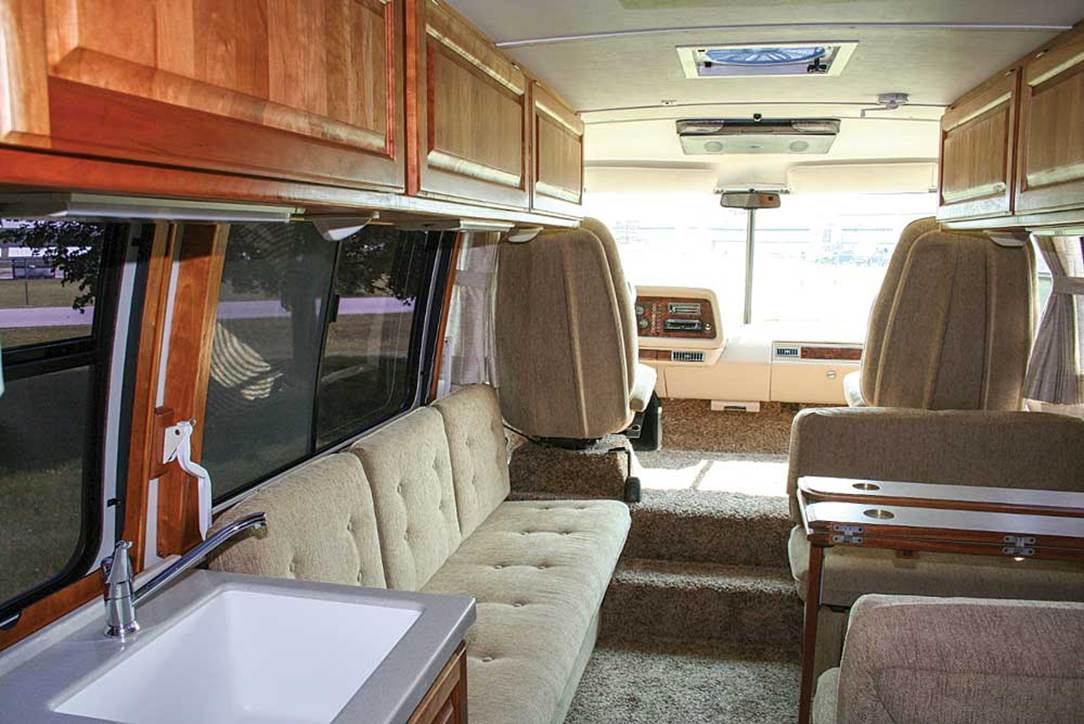
to the frame using adhesive. GMCs are notable for their large expanse of
windows, which redefined the RV industry at the time.
They often had luxury features common on upper models of GM
brands, such as cruise control, air conditioning, AM/FM/8-track sound
systems, an aluminum/fiberglass body, as well as air suspension. Rear lower compartments provide space for generators and propane
tanks. GMCs were optionally supplied with generators from Onan in 4,000 Watts
and 6,000 Watts, many of which are still in service. There were no driver's or passenger's doors at the front of the
vehicle. A single door amidships on the passenger side provided access to the
main passenger compartment. At the back of the vehicle, the entire rear body
panel could be removed by loosening the bolts around its edges. This allowed
beds, appliances, and other bulky items to be installed or removed.
A total of 12,921 GMC Motorhomes were produced from model years
1973 to 1978. The interior of the motorhome was constructed at the Gemini
Corporation plant in Mt. Clemens, Michigan in 1973 and 1974 before being
brought in house at GM for the remainder of production. Peter R. Fink, the
owner of Travco motor homes, was the CEO of Gemini. The Gemini operation
featured a progressive team concept with teams of workers constructing rooms
of the motor homes in full, rather than performing repetitive tasks on an assembly
line. Beginning operation in 1972, the plant featured state-of-the-art
equipment including one of the first programmable routers.
|

|
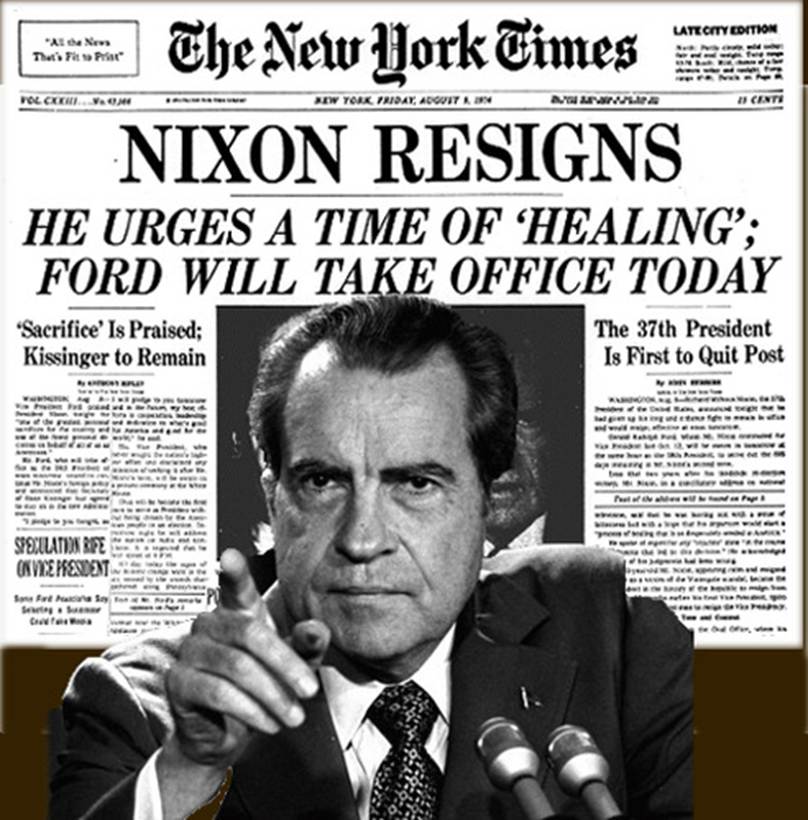
1974 🌍 4.0 billion President Nixon resigns, a political scandal in the United States involving the administration
of President Richard Nixon. The affair began on June 17, 1972, when members
of a group associated with Nixon's 1972 re-election campaign were caught
burglarizing and planting listening devices in the Democratic National
Committee headquarters at Washington, D.C.'s Watergate complex. Nixon's
efforts to conceal his administration's involvement led to an impeachment
process and his resignation in August 1974. Following the burglars' arrest, media and the Department of
Justice traced money to the Committee for the Re-Election of the President
(CRP), the fundraising arm of Nixon's campaign. The Washington Post reporters
Carl Bernstein and Bob Woodward pursued leads from a source named "Deep
Throat" (later identified as Mark Felt, FBI Associate Director) and
uncovered a campaign of political espionage directed by White House officials
and illegally funded by donor contributions. Nixon dismissed the accusations and won the election in a
landslide. Further investigation and revelations from the burglars' trial led
the Senate to establish a special Watergate Committee and the House of
Representatives to grant its Judiciary Committee expanded authority in
February 1973. The burglars received lengthy prison sentences, with the
promise of reduced terms if they cooperated—prompting a flood of witness
testimony. In April, Nixon denied wrongdoing and announced the resignation of
his aides. After it was revealed that Nixon had installed a voice-activated
taping system in the Oval Office, his administration refused to grant
investigators access to the tapes, leading to a constitutional crisis. Attorney General Elliot Richardson appointed Archibald Cox as a
special prosecutor for Watergate in May. Cox obtained a subpoena for the
tapes, but Nixon continued to resist. In the "Saturday Night
Massacre" in October, Nixon ordered Richardson to fire Cox, after which
Richardson resigned, as did his deputy William Ruckelshaus; Solicitor General
Robert Bork carried out the order. The incident bolstered a growing public belief that Nixon had
something to hide, but he continued to defend his innocence. In April 1974,
Cox's replacement Leon Jaworski reissued a subpoena for the tapes, but Nixon
only released redacted transcripts. In July, the Supreme Court ordered Nixon
to release the tapes, and the House Judiciary Committee recommended that he
be impeached for obstructing justice, abuse of power, and contempt of
Congress. In one of the tapes, known as "the smoking gun," he
ordered aides to tell the FBI to halt its investigation. On the verge of being impeached, Nixon resigned on August 9,
1974, becoming the only U.S. president to do so. In all, 48 people were found
guilty of Watergate-related crimes, but Nixon was pardoned by his vice
president and successor Gerald Ford on September 8. |
|
Rubik’s
cube invented by
Ernő Rubik born in Budapest, Hungary, on 13 July 1944, during World War
II, and has lived all of his life in Hungary. From 1971 to 1979, Rubik was a professor of architecture at the
Budapest College of Applied Arts (Iparművészeti Főiskola). It was
during his time there that he built designs for a three-dimensional puzzle
and completed the first working prototype of the Rubik's Cube in 1974,
applying for a patent on the puzzle in 1975. In an interview with CNN, Rubik
stated that he was "searching to find a good task for my students."
Rubik’s Cube Rubik showed his prototype to his class and his students liked it
very much. Rubik realized that because of the cube's simple structure, it
could be manufactured relatively easily and might have appeal to a larger
audience. Rubik then set out to find a manufacturer in Hungary, but had great
difficulty due to the rigid planned economy of communist Hungary at the time.
Eventually, Rubik was able to find a small company that worked with plastic
and made chess pieces. The cube was originally known in Hungary as the Magic
Cube. Rubik licensed the Magic Cube to Ideal Toys, a U.S. company, in
1979. Ideal rebranded The Magic Cube to the Rubik's Cube before it was
introduced to an international audience in 1980. The process from early
prototype to mass production of the Cube had taken over six years. The
Rubik's Cube became an instant success worldwide, won several Toy of the Year
awards, and became a staple of 1980s popular culture. To date, over 350
million Rubik's Cubes have been sold, making it one of the best selling toys
of all time. There are many approaches on how to solve the Rubik's Cube. All
these methods have different levels of difficulties, for speedcubers or
beginners, even for solving the cube blindfolded. With practice and the right
techniques, many speedcubers can solve a Rubik's Cube in under 30 seconds,
while world record holders have achieved times as low as 3.05 seconds. Beginners' Solution Tutorial: https://ruwix.com/the-rubiks-cube/how-to-solve-the-rubiks-cube-beginners-method/ There are 43 quintillion possible configurations of the original
cube. |