Home
About
Links
Hobbycraft
Photos
Downloads
|
Future
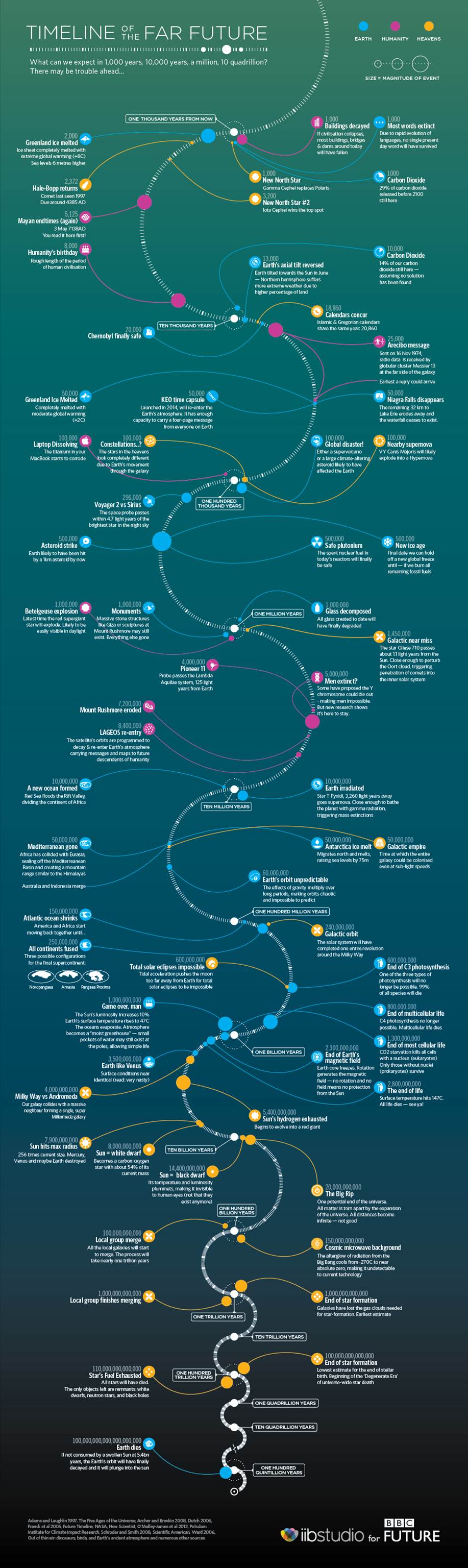
500,000,000
years from now The Sun's increasing luminosity begins to disrupt the
carbonate–silicate cycle; higher luminosity increases weathering of surface
rocks, which traps carbon dioxide in the ground as carbonate. As water
evaporates from the Earth's surface, rocks harden, causing plate tectonics to
slow and eventually stop once the oceans evaporate completely. With less
volcanism to recycle carbon into the Earth's
atmosphere, carbon dioxide levels begin to fall. By this time, carbon dioxide
levels will fall to the point at which C3 photosynthesis is no longer
possible. All plants that use C3 photosynthesis (roughly 99 percent of
present-day species) will die. The extinction of C3 plant life is likely to
be a long-term decline rather than a sharp drop. It is likely that plant groups
will die one by one well before the critical carbon dioxide level is reached.
The first plants to disappear will be C3 herbaceous plants, followed by
deciduous forests, evergreen broad-leaf forests, and finally evergreen
conifers. As Earth begins to warm and carbon dioxide levels fall,
plants—and, by extension, animals—could survive longer by evolving other
strategies such as requiring less carbon dioxide for photosynthetic
processes, becoming carnivorous, adapting to desiccation, or associating with
fungi. These adaptations are likely to appear near the beginning of the moist
greenhouse. The decrease in plant life will result in less oxygen in the
atmosphere, allowing for more DNA-damaging ultraviolet radiation to reach the
surface. The rising temperatures will increase chemical reactions in the
atmosphere, further lowering oxygen levels. Plant and animal communities
become increasingly sparse and isolated as the Earth becomes more barren.
Flying animals would be better off because of their ability to travel large
distances looking for cooler temperatures. Many animals may be driven to the
poles or possibly underground. These creatures would become active during the
polar night and aestivate during the polar day due to the intense heat and
radiation. Much of the land would become a barren desert, and plants and
animals would primarily be found in the oceans. This is the earliest time for plate tectonics to eventually
stop, due to the gradual cooling of the Earth's core, which could potentially
turn the Earth back into a water world. This would, in turn, likely cause the
extinction of Earth's remaining land life. 1,000,000,000,years from now The Sun's luminosity will have increased by 10%, causing Earth's
surface temperatures to reach an average of around 116 °F. The atmosphere
will become a "moist greenhouse", resulting in a runaway
evaporation of the oceans. This would cause plate tectonics to stop
completely, if not already stopped before this time. Pockets of water may
still be present at the poles, allowing abodes for simple life. Assuming some form of photosynthesis is possible despite
extremely low carbon dioxide levels. If this is possible, rising temperatures
will make any animal life unsustainable from this point on. Eukaryotic life dies out on Earth due to carbon dioxide
starvation. Only prokaryotes remain. 3,500,000,000
years from now the Sun's luminosity will have increased by 35–40%, causing all
water currently present in lakes and oceans to evaporate, if it had not done
so earlier. The greenhouse effect caused by the massive, water-rich
atmosphere will result in Earth's surface temperature rising to 2,060 °F,
which is hot enough to melt some surface rock 7,500,000,000
years from now The Earth and Moon are very likely destroyed by falling into the
Sun, just before the Sun reaches the top of its red giant phase. Before the
final collision, the Moon possibly spirals below Earth's Roche limit,
breaking into a ring of debris, most of which falls to the Earth's surface. Trillions
of years from now The Big Freeze, or Heat Death, is the most probable outcome
based on current cosmological data, which supports a universe expanding
forever at an accelerating rate. This scenario is governed by the second law
of thermodynamics, stating that the entropy, or disorder, of an isolated
system must increase over time. The universe will eventually reach a state of
maximum entropy where all energy is uniformly distributed, making it
impossible to perform work or sustain organized structures. The timeline for this end is vast. Within 100 trillion years,
the gas clouds required for star formation will be exhausted, ending the
“Stelliferous Era” and leaving the cosmos progressively darker. As expansion
continues, distant galaxies will recede so quickly that their light will no
longer reach us, isolating the remnants of our own Milky Way. The final stage involves the decay of all remaining matter. Even black holes will eventually evaporate over
immense timescales. This process involves the slow emission of particles
until the black hole vanishes. All that will remain is a thin, cold soup of
fundamental particles, such as photons and leptons, spread across a nearly
infinite, dark expanse, with the temperature approaching absolute zero. |