Home
About
Links
Hobbycraft
Photos
Downloads
|
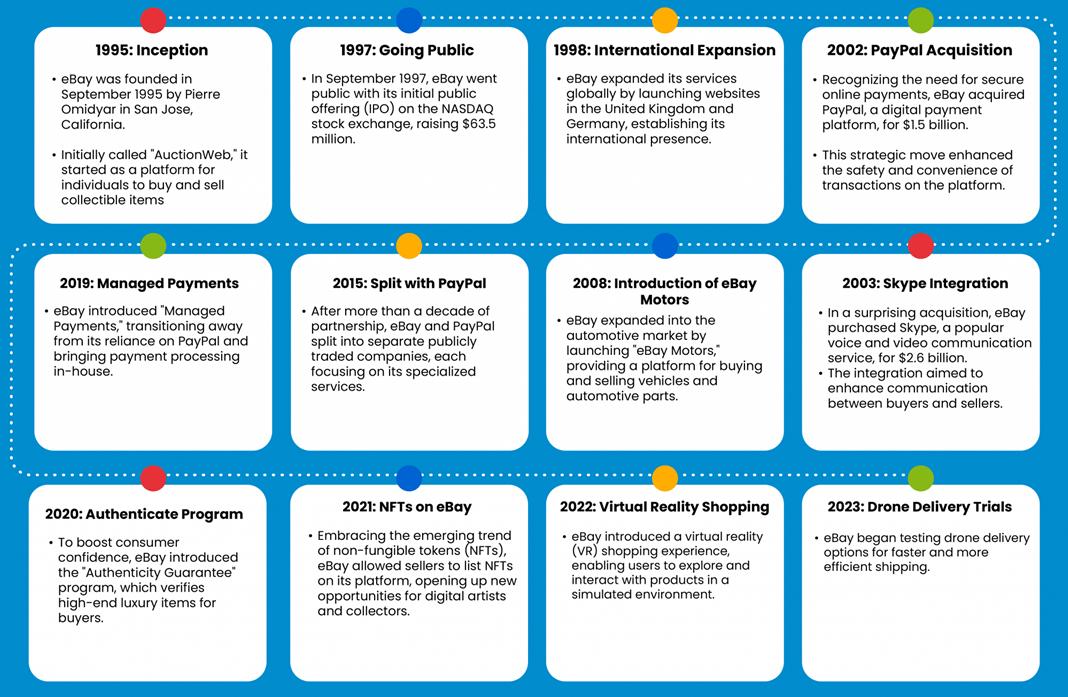
1995 eBay
is founded, revolutionized the way people buy and
sell items, transforming the concept of online shopping. Over the years, it
has grown into a global powerhouse, connecting millions of buyers and sellers
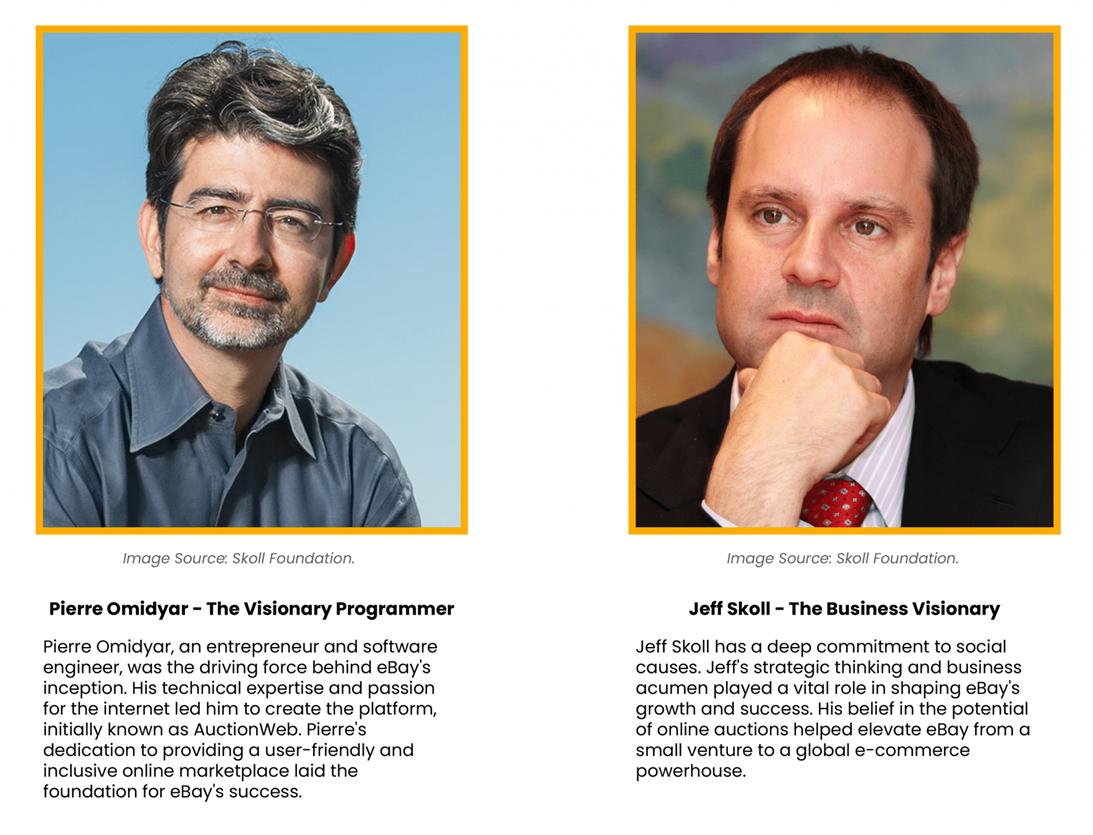
across the world. eBay was the brainchild of Pierre Omidyar, an entrepreneur and
software engineer, and his partner, Jeff Skoll, a visionary businessman.
Pierre's background in computer programming and his passion for the internet,
combined with Jeff's acumen for business and social causes, laid the
groundwork for eBay's innovative approach to e-commerce.
eBay played a pioneering role in popularizing online auctions
and redefined how people buy and sell goods. Prior to eBay, online auctions
were relatively unknown to the general public. The platform's success and
innovative features, such as the auction-style format, real-time bidding, and
time-limited listings, made online auctions accessible and exciting for
millions of users.
For buyers, the process begins with searching for the desired
item, followed by placing bids or purchasing products immediately through
“Buy It Now.” Sellers, on the other
hand, list their items with detailed descriptions and visuals, setting a
starting price or enabling bidding. The highest bidder wins the item at the
end of the auction period, or it sells instantly through “Buy It Now.” eBay's humble beginnings as an online auction platform led to
its global prominence as a major e-commerce player. Its pioneering role in
popularizing online auctions and contributions to online shopping have left a
lasting impact on the industry.
1998 The
Monica Lewinsky scandal begins when U.S. President Bill Clinton denies
his relationship with the White House intern in a televised interview. This
denial, and other denials to a grand jury investigation, would lead to the
impeachment of the president. Lewinsky stated that she had nine sexual encounters with
President Bill Clinton in the Oval Office between November 1995 and March
1997. According to her testimony, these encounters involved oral sex and
other sexual acts, but not sexual intercourse. In April 1996, Lewinsky's superiors transferred her from the
White House to the Pentagon because they felt that she was spending too much
time with Clinton. In September 1997, after Lewinsky told co-worker Linda
Tripp about her relationship with Clinton, Tripp began to secretly record
their telephone conversations. Tripp gave the tapes to Independent Counsel
Kenneth Starr, adding to his ongoing investigation into the Whitewater
controversy. Starr then broadened his investigation beyond the Arkansas land
use deal to include Lewinsky, Clinton, and others for possible perjury and
subornation of perjury in the Jones case. Tripp reported the taped
conversations to literary agent Lucianne Goldberg. She also convinced
Lewinsky to save the gifts that Clinton had given her during their
relationship and not to dry clean a blue dress that was stained with
Clinton's semen. Under oath, Clinton denied having had "a sexual
affair", "sexual relations", or "a sexual
relationship" with Lewinsky.
Lewinsky handed over the blue dress on July 28, 1998. Based on a
test of the stained dress itself and a blood sample given by Clinton, “the
FBI Laboratory concluded that the President was the source of the DNA
obtained from the dress.” The stained dress unequivocally proved that an
affair had taken place. Independent Counsel Kenneth Starr’s report to the House on
President Bill Clinton includes testimony from Lewinsky about a sexual
encounter involving a cigar. According to the testimony, Clinton inserted a
cigar into Lewinsky’s vagina during an encounter on March 31, 1996. Clinton
then put the cigar in his mouth and said, “It tastes good,” according to the
report.
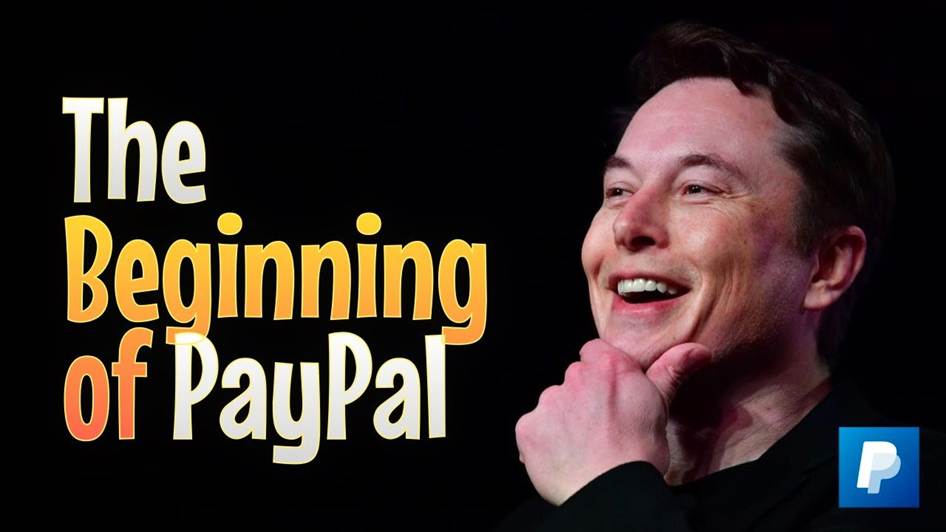
1999 Beginning
of PayPal, a money transfer service that Elon Musk launched, an online
payment service that allows users to send money via email. This service
quickly gains popularity, especially among eBay users. By 2000 PayPal’s
popularity grows to over 1 million users, largely thanks to eBay’s community
of online sellers. Before PayPal, sellers would make payments with checks and
money orders via US mail.
2002: PayPal goes public on the NASDAQ and is acquired by eBay
for $1.5 billion in stock, becoming the official payment provider for eBay
transactions. By 2011 PayPal grows to over 100 million active users in 190
markets and 25 currencies as it democratizes financial services for everyone.
A couple years later PayPal’s family of brands continues to
expand, adding Braintree and Venmo. Braintree becomes part of the PayPal
Commerce Platform, creating a full-stack payment service for businesses to
add online and in-app shopping for their customers. Venmo becomes the defacto digital wallet for college students
and small businesses because it makes money move easier for everyone. 2015 PayPal becomes an independent company once again and starts
trading on the Nasdaq stock exchange as “PYPL.” PayPal buys Xoom for nearly a
billion dollars, making it easier for customers to send money across borders
at a lower cost than traditional money transfers. Then in 2016 PayPal announces landmark partnership agreement
with Visa Inc. to expand consumer choice in payments. Since that time, PayPal
has forged more than 40 strategic partnerships, including with leading banks
like Bank of America, Banorte, Barclays, Citi, HSBC, JPMorgan Chase,
ShinhanCard and Wells Fargo, card networks and issuers like American Express,
Discover, Mastercard and other financial institution partners like FIS,
Paymentus and Synchrony.
2000 International
Space Station becomes
fully operational with the arrival of its first resident crew. Assembly of the International Space Station (ISS) began with the
launches of the Russian control module Zarya on November 20, 1998, and the
U.S.-built Unity connecting node the following month, which were linked in
orbit by U.S. space shuttle astronauts. In mid-2000 the Russian-built module
Zvezda, a habitat and control center, was added, and on November 2 of that
year the ISS received its first resident crew, comprising Russian cosmonauts
Sergey Krikalev and Yuri Gidzenko and American astronaut William Shepherd,
who flew up in a Soyuz spacecraft. The ISS has been continuously occupied
since then.
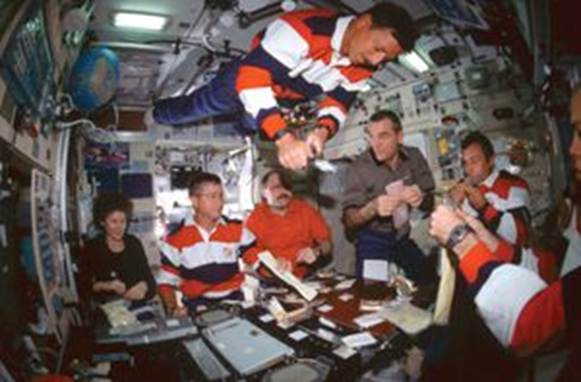
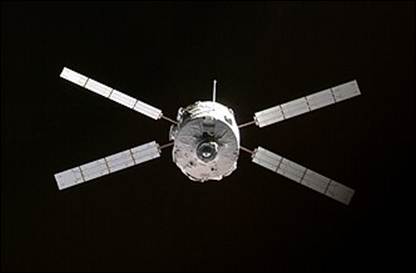
Crews from three countries having a meal in the Zvezda module In March 2008 an improved variant of the Ariane V rocket
launched Europe’s heaviest spacecraft, the Jules Verne Automated Transfer
Vehicle (ATV), which carried 7,700 kg (17,000 pounds) of supplies to the ISS.
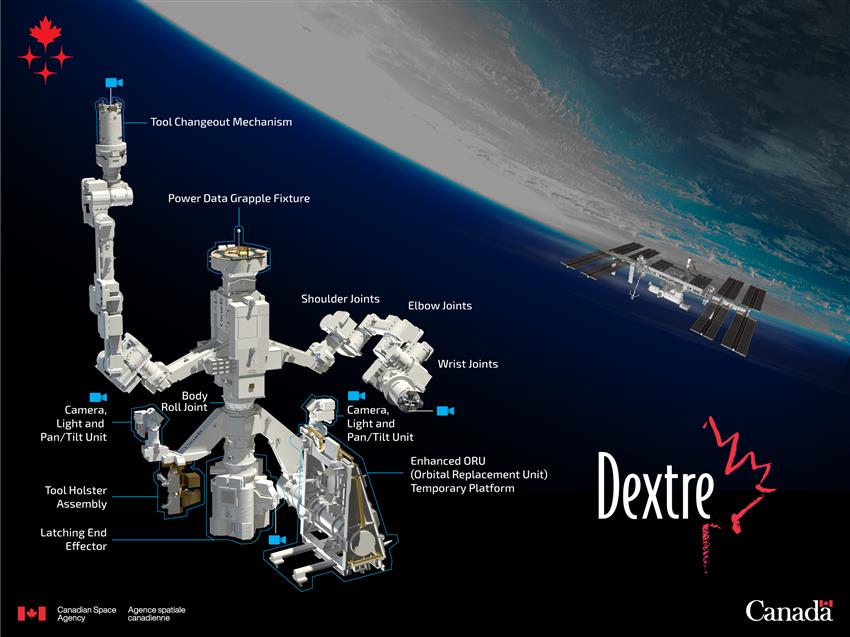
Jules Verne ATV Also in March shuttle astronauts brought the Canadian robot,
Dextre, which was so sophisticated that it would be able to perform tasks
that previously would have required astronauts to make space walks, and the
first part of Kibo. In June 2008 the main part of Kibo was installed.
The ISS became fully operational in May 2009 when it began
hosting a six-person crew; this required two Soyuz lifeboats to be docked
with the ISS at all times. The six-person crew typically consisted of three
Russians, two Americans, and one astronaut from either Japan, Canada, or the
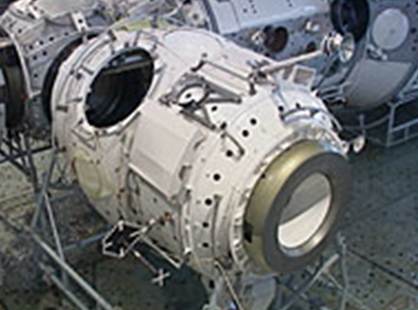
ESA. An external platform was attached to the far end of Kibo in July, and a
Russian docking port and airlock, Poisk, was attached to the Zvezda module in
November.
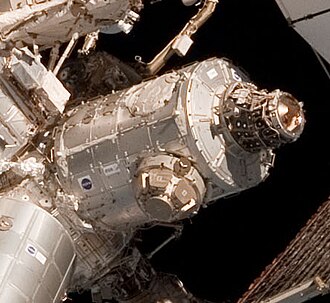
Russian docking port Poisk A third node, Tranquility, was installed in 2010, and mounted on
this was a cupola, whose robotic workstation and many windows enabled
astronauts to supervise external operations.
Tranquility node After completion of the ISS, the shuttle was retired from
service in 2011. Thereafter, the ISS was serviced by Russia’s Progress,
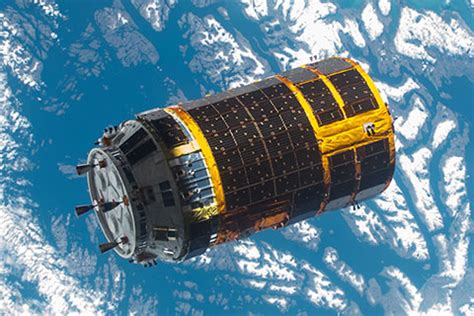
Europe’s ATV (from 2008 to 2015), Japan’s H-II Transfer Vehicle (HTV, from
2009 to 2020)
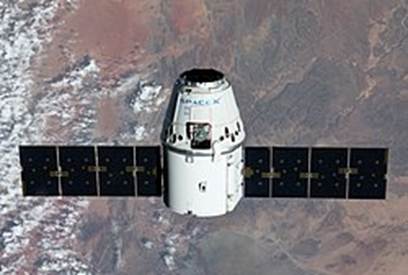
Japan’s H-II transfer vehicle and HTV-X (from 2025), and two commercial cargo vehicles,
SpaceX’s Dragon (from 2010)
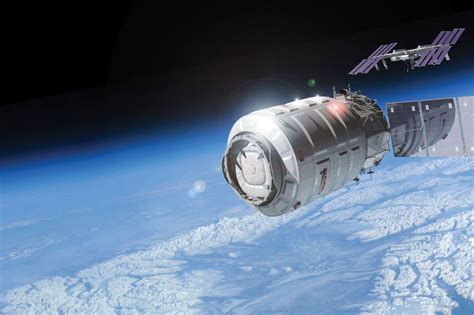
SpaceX’s Dragon and Orbital Sciences
Corporation’s Cygnus (from 2013).
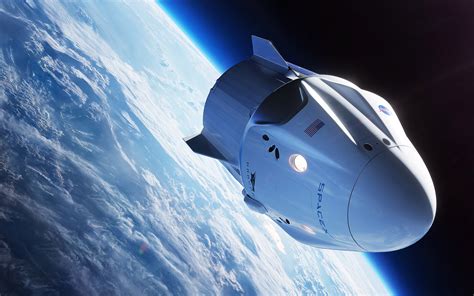
Orbital Science’s Cygnus A new American crew capsule, SpaceX’s Crew Dragon, had its first
flight to the ISS in 2020. Prior to Crew Dragon, all astronauts used Soyuz
spacecraft to reach the ISS. Crew Dragon carried four astronauts to the
station, and the ISS was then able to accommodate a crew of seven. A Russian
science module, Nauka, was added to the station in 2021.
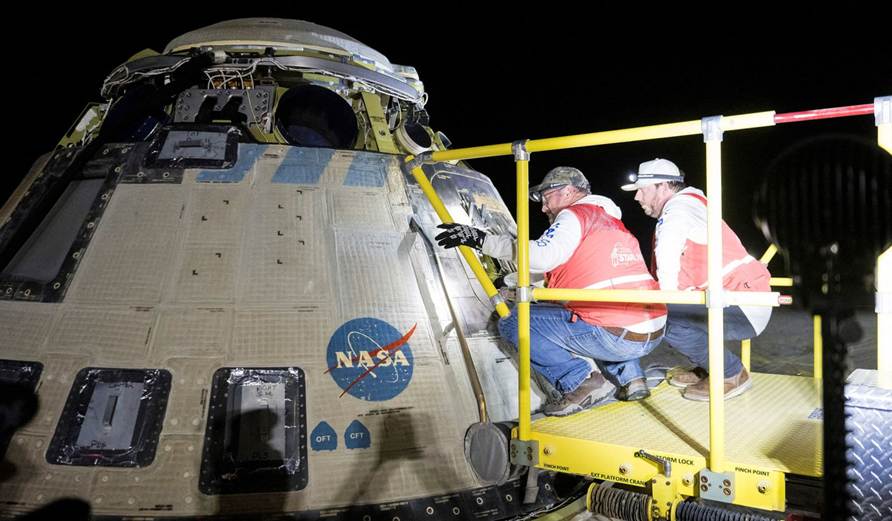
SpaceX’s Crew Dragon The Boeing Company’s CST-100 Starliner had its first crewed test
flight on June 5, 2024.
Boeing CST-100 Starliner However, during the flight to the ISS, five thrusters failed,
and helium leaks were detected in its propulsion system. NASA delayed
Starliner’s return to Earth until it was sure that the craft could reenter
safely. The two Starliner astronauts, commander Barry Wilmore and pilot
Sunita Williams, had been scheduled to be in space for about a week. They
returned to Earth on a Crew Dragon on March 18, 2025, after NASA returned the
Starliner to Earth empty. More than 280 astronauts from 26 different countries have
visited the ISS. Astronauts typically stay on the ISS for about six months.
The return of a Soyuz to Earth marks the end of an ISS Expedition, and the
command of the ISS is transferred to another astronaut. However, a few astronauts have spent much longer times on the
ISS. On a special mission called “A Year in Space,” Russian cosmonaut Mikhail
Korniyenko and American astronaut Scott Kelly spent 340 days in orbit from
March 2015 to March 2016. Kelly’s flight was the longest by an American.
(Since Kelly’s brother, Mark, was his identical twin, as well as a former
astronaut himself, scientists were able to use Mark as a baseline for how the
long spaceflight had changed Scott.) In 2017 Russia temporarily cut the number
of its ISS crew from three to two, and American astronaut Peggy Whitson
extended her mission to 289 days, which at that time was the longest single
spaceflight by a woman, so the station would have a full crew of six. Whitson
has been to the ISS on three other flights and in total has spent more than
675 days in space, a record for an American and a woman. Whitson’s longest
consecutive spaceflight record was surpassed by American astronaut Christina
Koch, who spent 328 days on the ISS from March 2019 to February 2020. During
that time Koch and American astronaut Jessica Meir performed the first
all-female space walk. Russian cosmonaut Pyotr Dubrov and American astronaut
Mark Vande Hei stayed on the station for 355 days from April 2021 to March
2022. Vande Hei broke Kelly’s record for longest American spaceflight. The ISS has also been a destination for space tourists. The
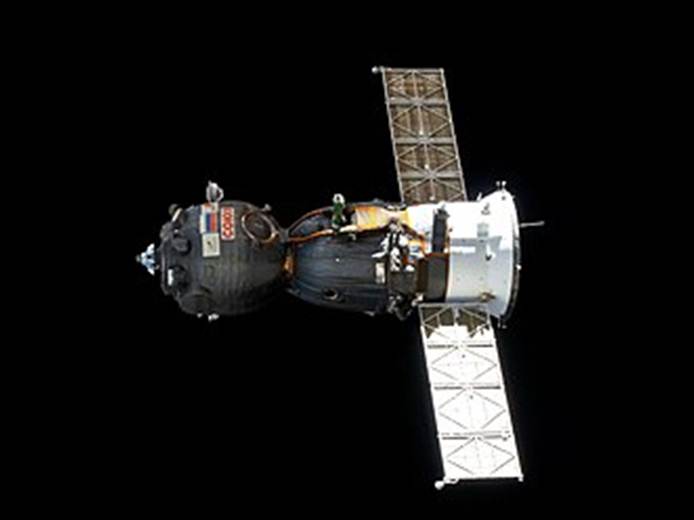
first such, American businessman Dennis Tito, flew to the ISS on a Soyuz
spacecraft on April 28, 2001
Soyuz spacecraft Eight other individuals paid for seats on Soyuz flights to ISS
between 2002 and 2021. Beginning in 2022, the American company Axiom Space
has chartered flights on Crew Dragon spacecraft to the ISS. On some Axiom
flights, the passengers have been astronauts whose seat was paid for by their
country’s space agency, such as Indian astronaut Shubhanshu Shukla, who flew
to the ISS on Axiom Mission 4 on June 25, 2025. Astronauts on chartered
flights typically only stay on the ISS for a few weeks. The United States, ESA, Japan, and Canada have not definitively
decided when the program will end, but in 2021 the Joe Biden administration
indicated that the program would receive U.S. support through 2030. The ESA,
Japan, and Canada have also committed to support the ISS through 2030. Russia
announced that it would support the station through 2028 and then begin work
on its own orbital space station. |